If you have read our articles on SWOT analysis and management system scope, you will already understand that ISO standards place significant weight on an organisation knowing its context. Clause 4.1 of ISO 9001, ISO 14001, and other standards built on the High Level Structure (Annex SL) requires you to identify the external and internal issues that are relevant to your purpose and that could affect your ability to achieve the outcomes your management system is designed to deliver.
The SWOT analysis is one tool for doing this. PESTLE is another - and the two work best when used together. Where SWOT gives you a broad picture of your business, PESTLE helps ensure you have looked carefully enough at the world outside it.
What Does PESTLE Stand For?
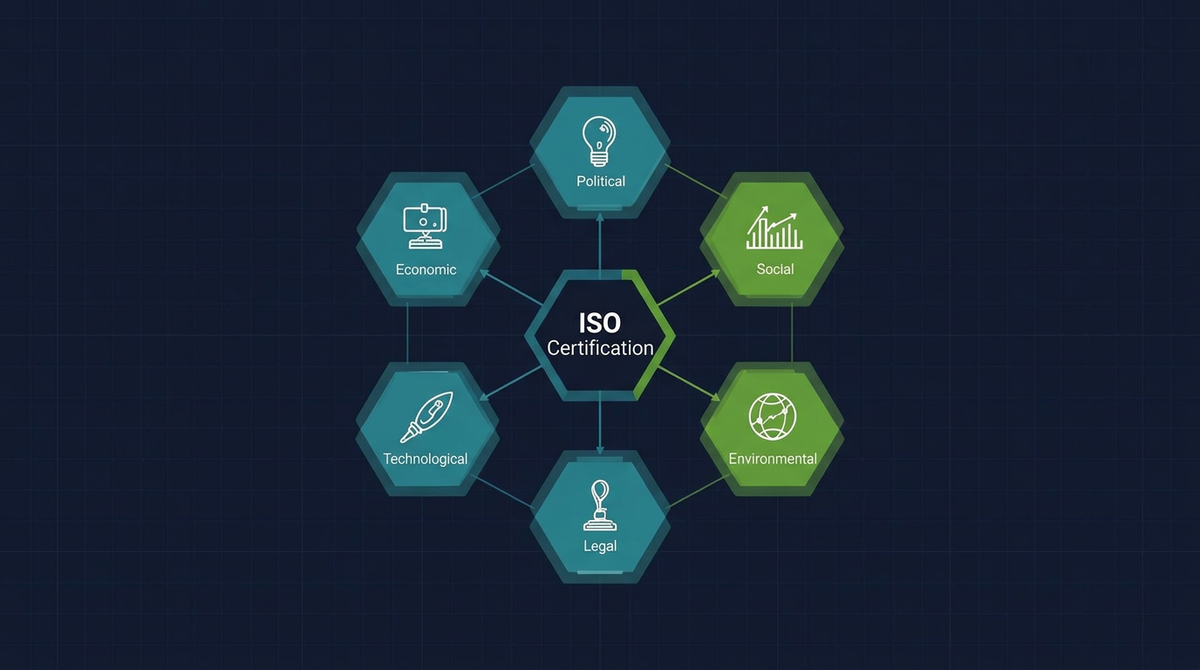
PESTLE is an acronym covering six categories of external factor:
- Political - government policy, political stability, trade agreements, taxation policy, and the regulatory environment in the markets you operate in or supply to.
- Economic - interest rates, inflation, exchange rates, employment levels, consumer confidence, and the overall health of the economy in your sector or region.
- Social - demographic trends, cultural shifts, changing consumer expectations, workforce attitudes, and societal values that affect how your business operates or how your products and services are received.
- Technological - emerging technologies, automation, digitalisation, cybersecurity risks, and the pace of change in the tools and platforms relevant to your industry.
- Legal - employment law, health and safety legislation, industry-specific regulation, data protection requirements, and any legal obligations that govern how you operate.
- Environmental - climate change, weather-related risks, resource scarcity, waste regulation, sustainability expectations from customers and investors, and the physical environmental conditions that could affect your operations or supply chain.
Each of these categories represents a dimension of the external world that your organisation cannot control but must understand and respond to. That is precisely why ISO standards ask you to consider them.
How Does PESTLE Differ from SWOT?
A common question is why both tools are needed. The honest answer is that neither is sufficient on its own for ISO purposes.
Think of it using an analogy. If your management system is a building, SWOT gives you an architect's overview - it shows you the whole structure, inside and out, including its strengths and where it needs work. PESTLE, by contrast, is the structural survey that focuses specifically on the ground the building sits on. It does not look at the building itself at all; it examines the external environment in detail, systematically, category by category, to make sure nothing has been missed.
SWOT is broad but can be inconsistent - it relies on participants thinking of the right external factors spontaneously. PESTLE is structured and exhaustive by design. Running a PESTLE analysis before completing the external sections of your SWOT makes it considerably less likely that a significant factor will be overlooked.
For ISO purposes, the two tools complement each other naturally. PESTLE populates the raw material for your external analysis. SWOT then frames that material alongside your internal factors, and the combined output feeds your risk register and your management system objectives.
Why PESTLE Matters Specifically for ISO Standards
Each of the six PESTLE categories maps directly onto concerns that ISO standards require you to address.
Political and Legal Factors
Political and Legal factors are particularly relevant to ISO 9001 and ISO 14001 because both standards require you to identify and comply with applicable legal and regulatory requirements. A PESTLE analysis forces you to ask systematically: what legislation governs our activities, and has anything changed recently? For businesses operating across borders - supplying into the US from the UK, for instance, or working with European clients post-Brexit - the political and legal dimensions can be especially complex.
Economic Factors
Economic factors feed directly into your risk register. A sudden rise in raw material costs, a tightening of credit conditions, or a downturn in your primary market are all threats that an auditor would expect to see acknowledged and planned for. Economic instability is one of the most common sources of significant risk for SMEs, and yet it is frequently underrepresented in management system documentation.
Social Factors
Social factors matter because ISO standards - particularly ISO 9001 - place strong emphasis on understanding customer requirements and the expectations of interested parties. Shifting customer values, changing workforce expectations, or demographic trends affecting your talent pipeline are all social factors with direct implications for your quality management system.
Technological Factors
Technological factors are increasingly significant. For ISO 9001, new technology affects how products are designed, manufactured, and delivered. For ISO 14001, it may create both opportunities (cleaner production methods, more efficient resource use) and risks (new environmental hazards, compliance obligations around digital waste or energy consumption). ISO 42001, the AI management standard, is in many ways a direct response to the technological dimension of PESTLE becoming too significant for existing standards to absorb.
Environmental Factors
Environmental factors deserve particular attention in the context of ISO 9001:2026. The updated Clause 4.1 now explicitly requires organisations to consider whether climate change is a relevant issue for their management system. The Environmental dimension of PESTLE is the natural home for this assessment. Factors to consider include physical climate risks (flooding, extreme heat, supply chain disruption caused by weather events), transition risks (regulatory changes driving a shift to low-carbon operations), and the expectations of customers and investors regarding your environmental performance.
How to Conduct a PESTLE Analysis
Like SWOT, PESTLE works best as a collaborative exercise rather than a solo effort. The following process works well for most SMEs.
Step 1: Gather the right people
Include representatives from across the business - not just leadership. Your sales team will have a feel for shifting customer expectations (Social). Your operations manager will know about supply chain pressures (Economic, Environmental). Your finance lead will be alert to regulatory changes (Legal, Political). Diversity of perspective is what makes a PESTLE analysis genuinely useful.
Step 2: Work through each category in turn
Take each of the six letters and ask: what is happening in this area that is relevant to our business? Use open questions to prompt discussion:
- What government policies or political developments could affect how we operate or who we can sell to? (Political)
- What economic conditions are creating pressure or opportunity for us right now? (Economic)
- How are our customers' expectations or our workforce's attitudes changing? (Social)
- What new technologies are changing our industry - for better or worse? (Technological)
- What legal or regulatory changes are on the horizon that we need to prepare for? (Legal)
- What environmental conditions or climate-related factors could affect our operations or supply chain? (Environmental)
Do not filter during the brainstorm. Record everything and evaluate afterwards.
Step 3: Assess significance
Once you have a list of factors under each heading, consider the significance of each one. A useful way to do this is to rate each factor on two dimensions: how likely it is to affect your business, and how serious the impact would be if it did. Factors that score highly on both dimensions should flow directly into your risk register as priority items.
Step 4: Feed the outputs into your management system
The PESTLE analysis is not a standalone document - it is an input. Its outputs should inform your SWOT analysis (particularly the Opportunities and Threats quadrants), your risk and opportunity register, your interested parties register, and ultimately your management system objectives. Document the analysis, record who participated and when it was conducted, and make sure it is reviewed at least annually.
An Example: Hartley Precision Engineering Ltd
Returning to our fictional Sheffield manufacturer, here is how a PESTLE analysis might look in practice.
| Category | Findings |
|---|---|
| Political | Post-Brexit trade arrangements continue to affect the cost and lead time of specialist steel imports from European suppliers. Potential changes to public procurement policy could open new opportunities in infrastructure contracts, but require quality accreditation as a condition of eligibility. |
| Economic | Rising energy costs are increasing the running cost of CNC machinery significantly. A slowdown in commercial construction activity has softened demand from two of Hartley's three major customers, increasing revenue concentration risk. |
| Social | There is growing difficulty recruiting skilled machinists locally, with younger workers showing less interest in traditional manufacturing careers. Customers are beginning to ask suppliers about their sustainability credentials as part of procurement decisions. |
| Technological | New CNC software offers significant improvements in precision and material efficiency, but requires capital investment and retraining. Cybersecurity risks are increasing as more of Hartley's customers require digital integration for order management and quality reporting. |
| Legal | Updated health and safety guidance on machinery noise exposure requires a review of current controls. Changes to waste disposal regulations affect how Hartley handles metal swarf and cutting fluids. |
| Environmental | Hartley's primary steel supplier has flagged potential disruption to logistics due to flooding risk at their distribution hub. Customer pressure to demonstrate a reduced carbon footprint is increasing, with two clients now including environmental criteria in their supplier assessments. |
From this analysis, several items flow directly into Hartley's risk register - including the steel supply chain disruption (which also satisfies the ISO 9001:2026 Clause 4.1 climate change requirement), the recruitment challenge, and the regulatory updates requiring action. The opportunity around public procurement contracts feeds into Hartley's quality objectives, reinforcing the business case for pursuing ISO 9001 certification in the first place.
PESTLE for ISO 14001: An Additional Layer
For organisations implementing or maintaining ISO 14001, the Environmental dimension of PESTLE takes on even greater significance. ISO 14001 requires you not only to identify environmental aspects and impacts, but also to understand the external context in which your environmental management system operates - including legal requirements, the expectations of interested parties, and local environmental conditions.
A well-constructed PESTLE analysis for ISO 14001 purposes would look carefully at factors including current and anticipated environmental legislation, the physical characteristics of the areas in which you operate (proximity to watercourses, air quality designations, protected habitats), the environmental expectations of your customers and investors, and sector-specific guidance from your industry body or regulator.
This is also where the link between ISO 14001 and ISO 9001 becomes practically useful. If you operate an integrated management system covering both standards, a single PESTLE analysis - conducted thoroughly - can serve as the external context assessment for both, provided it is sufficiently detailed across all six dimensions.
How Often Should You Revisit Your PESTLE Analysis?
At minimum, annually - ideally as part of your management review cycle, so that any significant changes to the external environment are formally considered by leadership and reflected in your risk register and objectives.
In practice, the external environment can change faster than an annual review cycle allows for. A new piece of legislation, a significant shift in your market, or a climate-related event affecting your supply chain may require an interim review. Building a habit of monitoring the external environment continuously - and having a clear process for escalating significant changes to your management system - is more valuable than a thorough annual exercise followed by eleven months of inattention.
PESTLE, SWOT, and Scope: Putting It All Together
Across this series of articles, we have introduced three tools that work together as the analytical foundation of any ISO management system:
- PESTLE examines the external environment in detail, systematically and category by category, ensuring nothing significant is missed.
- SWOT frames those external findings alongside your internal strengths and weaknesses, giving leadership a complete picture of where the organisation stands.
- Scope translates that understanding into a formal declaration of what your management system covers - the boundary within which all of your risks, processes, and controls sit.
Together, these three tools satisfy the requirements of Clause 4 across the ISO High Level Structure standards, and provide the evidential foundation that auditors look for when assessing whether your management system is genuinely embedded in how your organisation operates - rather than existing simply on paper.
Finding Expert Support
If you are working through a PESTLE analysis for the first time, or want to ensure your existing context analysis is robust enough to withstand auditor scrutiny, an experienced ISO consultant can add significant value. They will bring sector-specific knowledge of the political, legal, and environmental factors most likely to be relevant to your business, and can help you translate the outputs into a risk register and set of objectives that genuinely reflect your situation.
The ISOCentral directory lists consultants across the UK and US who specialise in management system implementation and transition support. Whether you are preparing for your first certification or updating your system ahead of the ISO 9001:2026 transition, finding the right expertise early makes the process considerably more straightforward.