If you are considering ISO certification for your business, there is a good chance you have already come across the phrase "understanding the context of your organisation." It appears in Clause 4.1 of ISO 9001, ISO 14001, and several other standards. It sounds deceptively simple. In practice, it means being able to demonstrate - in writing, to an auditor - that you genuinely understand the internal and external factors that shape how your business operates.
A SWOT analysis is one of the most practical tools available for doing exactly that.
What Is a SWOT Analysis?
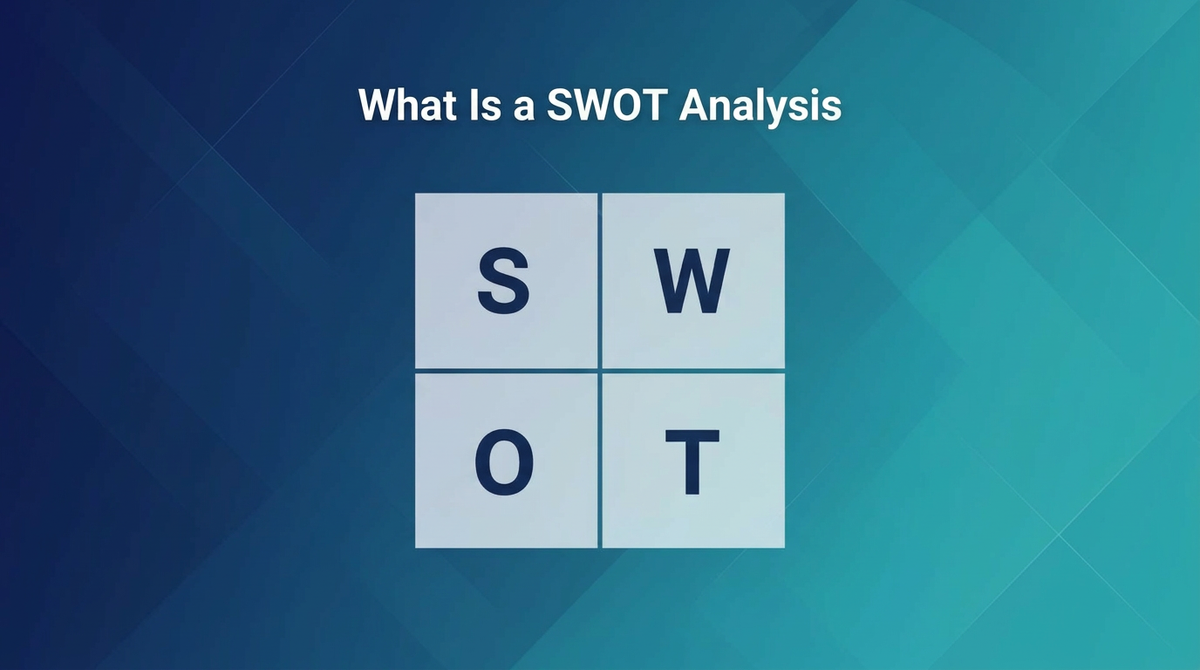
SWOT stands for Strengths, Weaknesses, Opportunities, and Threats. It is a structured way of taking stock of your business: what you do well, where you fall short, what the outside world offers you, and what it might do to harm you.
Think of it like a health check. Just as a GP looks at both your current condition and the risks you face in future, a SWOT analysis looks at both your internal reality and the external environment around you.
The framework splits neatly into two halves:
- Internal factors (things within your control): Strengths and Weaknesses
- External factors (things outside your control): Opportunities and Threats
This distinction matters enormously for ISO, as we will come to shortly.
Breaking Down the Four Quadrants
Strengths are the things your organisation genuinely does well. These might include an experienced team, loyal customers, a strong reputation in your sector, proprietary processes, or financial stability. Be honest here - only list things that are real advantages, not aspirations.
Weaknesses are internal shortcomings that put you at a disadvantage. High staff turnover, outdated equipment, gaps in documented procedures, or over-reliance on a single client would all qualify. This quadrant tends to make people uncomfortable, but it is arguably the most valuable one. An auditor would far rather see that you have identified and are managing your weaknesses than discover them independently.
Opportunities are external conditions that your business could benefit from. A growing market, a competitor closing down, new technology that reduces your costs, or changing regulations that favour your services are all examples. These are things happening in the world around you that you could take advantage of.
Threats are external conditions that could harm your business. Economic downturns, new competitors entering your market, rising material costs, supply chain instability, or - increasingly relevant for ISO 9001:2026 - the effects of climate change on your operations.
How to Conduct a SWOT Analysis
There is no single correct way to run a SWOT, but the following approach works well for most SMEs.
Step 1: Assemble the right people
A SWOT is not a solo exercise. Include people from different parts of the business - operations, sales, finance, and any customer-facing roles. The person answering the phone often knows about weaknesses and customer-facing threats that leadership may not see clearly.
Step 2: Set the scope
Decide what you are analysing before you begin. For ISO purposes, this is typically the entire organisation (or the part covered by your management system scope). Make a note of this - your auditor may ask.
Step 3: Brainstorm each quadrant
Work through each of the four areas in turn. Use open questions to prompt discussion:
- What do our customers say we do better than anyone else? (Strengths)
- Where do we lose business, make mistakes, or feel stretched? (Weaknesses)
- What trends in our market or sector could we take advantage of? (Opportunities)
- What external factors keep leadership awake at night? (Threats)
Capture everything at first. You can refine later.
Step 4: Prioritise and evaluate
Not all items carry equal weight. Once you have a full list, review each item and consider its significance. A threat that is highly likely and would cause serious disruption deserves more attention than a minor inconvenience that rarely materialises.
Step 5: Link findings to action
The SWOT analysis itself is not the end product - it feeds into your risk register, your objectives, and your management review. The output should inform what you do next, not sit in a drawer.
Three Common Approaches
Depending on the size and complexity of your business, you might choose one of the following formats.
The Workshop Approach
Bring your leadership team together for a structured half-day session. A facilitator (internal or external) guides the group through each quadrant using sticky notes or a whiteboard. This works well for businesses with five or more people in the room.
The Individual Assessment
For very small businesses or sole traders, the owner or director completes the SWOT alone or with one trusted colleague. This is quicker but risks blind spots. If you take this approach, it is worth sharing the draft with someone outside the business - an accountant, a mentor, or a consultant - to sense-check your thinking before finalising it.
The PESTLE-Assisted Approach
PESTLE stands for Political, Economic, Social, Technological, Legal, and Environmental. It is a complementary tool that helps ensure you have considered all the relevant external factors before populating the Opportunities and Threats sections of your SWOT. Many ISO consultants recommend using PESTLE first, then feeding its outputs into the external half of your SWOT. For ISO 9001:2026 in particular, the Environmental dimension of PESTLE is where your climate change assessment naturally sits.
An Example: Hartley Precision Engineering Ltd
Hartley Precision Engineering is a fictional SME with 22 employees, manufacturing specialist components for the construction sector. They are preparing for ISO 9001:2026 certification.
| Helpful | Harmful | |
|---|---|---|
| Internal | Strengths | Weaknesses |
| Long-standing relationships with three major contractors | No formal documented procedures - processes rely on individual knowledge | |
| Highly skilled workforce with low turnover | Ageing CNC machinery increasing downtime and rework rates | |
| Strong on-time delivery record | No dedicated quality manager - responsibility is shared informally | |
| External | Opportunities | Threats |
| Growing demand for precision components in sustainable construction projects | Two new competitors entering the regional market, offering lower prices | |
| Potential to supply into the defence sector if quality accreditation is achieved | Rising steel and aluminium costs squeezing margins | |
| ISO 9001 certification would open tender eligibility with several target clients | Climate-related disruption to their primary steel supplier's logistics |
From this SWOT, Hartley's transition plan prioritises three things: documenting their underpinning processes (addressing the most significant weakness), registering for ISO 9001 to unlock new tender opportunities (capitalising on the most valuable opportunity), and adding their steel supplier's climate-related logistics risk to their risk register (responding to the new Clause 4.1 requirement in ISO 9001:2026).
Notice how the SWOT does not just describe the business - it directly informs what the management system needs to focus on.
Why ISO Standards Require This Thinking
ISO management system standards are built around a simple but powerful idea: that a well-run organisation understands its context and makes decisions based on that understanding. The SWOT analysis is the practical mechanism for meeting that expectation.
Specifically, under Clause 4.1 of ISO 9001:2026, you must determine the external and internal issues that are relevant to your organisation's purpose and that affect your ability to achieve the intended outcomes of your quality management system. A well-constructed SWOT provides exactly this evidence.
It also feeds directly into Clause 6.1, which requires you to identify and address risks and opportunities. Your Threats and Weaknesses become the basis of your risk register. Your Opportunities and Strengths inform the opportunities you commit to pursuing.
And with the new Clause 4.1 climate change requirement introduced for 2026, the Threats quadrant of your SWOT is now the natural home for your climate relevance assessment - whether that is supply chain disruption, increased energy costs, or changing regulations affecting your sector.
An auditor reviewing your SWOT analysis is not just looking for a completed template. They want to see that your leadership team has genuinely engaged with these questions, and that the answers have shaped your quality management system in a meaningful way. A SWOT analysis that feeds into a live risk register and informs your management review agenda is one that will hold up to scrutiny. One that was produced once and never revisited will not.
How Often Should You Update Your SWOT Analysis?
At a minimum, your SWOT analysis should be reviewed annually as part of your management review. It should also be revisited whenever something significant changes - a new major customer, a key member of staff leaving, a shift in market conditions, or a relevant regulatory change. For ISO purposes, the review date and any changes made should be recorded.
Finding Expert Support
If the idea of conducting a SWOT analysis as part of your ISO preparation feels daunting, you do not need to do it alone. An experienced ISO consultant can facilitate the process, ensure the output is structured in a way that satisfies auditors, and help you translate findings into a working risk register.
The ISOCentral directory lists vetted ISO consultants across the UK and US who specialise in helping SMEs navigate exactly this kind of preparation work.