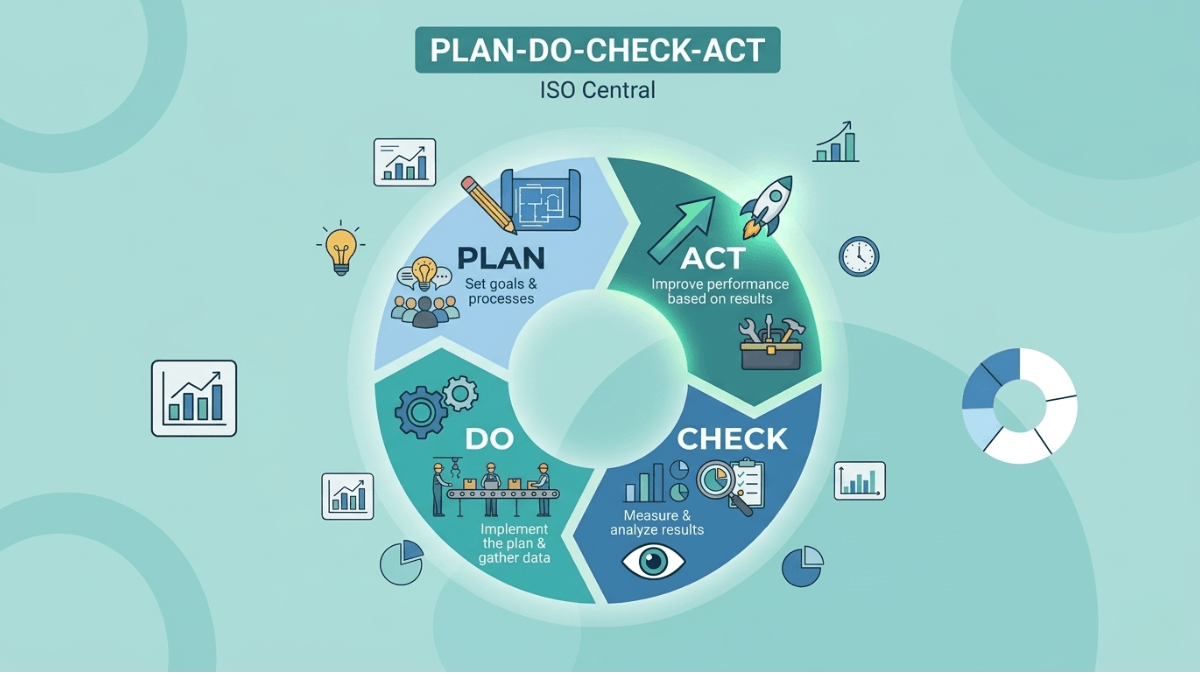
The Loop That Drives Every ISO Standard
Imagine the thermostat on your office wall. It does not simply switch the heating on and then walk away. It monitors the temperature, compares it against the target, adjusts the output, and checks again. Continuously, without end. That loop is exactly how Plan-Do-Check-Act works, and it is the reason why every major ISO management system standard is built around it.
Plan-Do-Check-Act, almost always abbreviated to PDCA, is a four-stage cycle for managing and improving any process or system. You plan what you want to achieve, you put the plan into practice, you check whether it worked, and then you act on what you have learned. Then you go around again.
If you are preparing for ISO certification or trying to understand what your management system is actually supposed to do in practice, PDCA is the most important concept to grasp. It is not a quality management tool in the narrow sense of that phrase. It is the operating logic of ISO 9001, ISO 14001, ISO 45001, and ISO 27001, as well as many other standards. Understanding it will make every other element of the certification process easier to navigate.
This article explains what PDCA is, where it came from, how its four stages work in practice, and how to start applying it in your business, whether you are working towards certification or simply trying to run a more consistent operation.
A Brief History: Where PDCA Came From
PDCA did not originate with ISO. It has its roots in statistical process control, the discipline of using data to manage the variation in industrial processes. The American engineer Walter Shewhart developed the earliest version of the cycle in the 1930s at Bell Laboratories. His insight was straightforward: improvement is not a single act but a repeating sequence of hypothesis, test, and review.
It was W. Edwards Deming, one of the most influential figures in modern quality management, who carried the concept forward and gave it wider prominence. Deming taught the cycle extensively in Japan during the post-war reconstruction period, and it became a cornerstone of Japanese manufacturing philosophy. He later refined it into a variant called Plan-Do-Study-Act (PDSA), arguing that the word 'study' better captured the analytical intent of the third stage than 'check'. Both versions remain in use today, and the distinction between them is covered in the FAQ section at the end of this article.
ISO formally adopted the PDCA structure when it introduced the Harmonised Structure (previously known as Annex SL) in 2012. This gave all ISO management system standards the same high-level framework, and that framework is explicitly organised around the four stages of PDCA. The practical consequence is significant: if you understand PDCA, you understand the underlying logic of every management system standard you are likely to encounter.
The Four Stages Explained
To bring the four stages to life, we will follow a single scenario throughout this section. Hartley Precision Engineering Ltd is a Sheffield-based precision manufacturer producing machined components for the aerospace and automotive sectors. The business employs 45 people and holds ISO 9001 certification.
Over the course of a quarter, Hartley's quality manager notices an increase in customer complaints relating to dimensional tolerances on a specific family of turned components. The business decides to address this through a structured PDCA cycle.
Plan: Define the Problem and Set a Direction
The Plan stage is where you establish what you are trying to achieve and how you intend to get there. It begins with a clear definition of the problem or improvement opportunity, moves through root cause analysis, and concludes with a documented plan that sets measurable objectives and identifies the resources and actions required.
Measurable objectives are important here. A target of 'improve quality' tells you nothing about whether you have succeeded. A target of 'reduce dimensional tolerance nonconformities by 80 per cent within three months' gives you something to evaluate against.
Common tools used in the Plan stage include the 5 Whys technique (asking 'why' repeatedly until you reach the underlying cause rather than the symptom) and cause-and-effect diagrams, sometimes called fishbone or Ishikawa diagrams. Risk assessment also belongs here: what could prevent the plan from working, and how should those risks be managed?
Hartley Precision: The quality manager facilitates a 5 Whys session with the CNC operators. The investigation traces the tolerance nonconformities to accelerated tool wear on a specific machine, caused by a tool replacement schedule that had not been reviewed since a change in material specification eighteen months earlier. Objective set: reduce tolerance nonconformities by 80 per cent within three months by revising the tool replacement schedule and adding in-process inspection checkpoints.
Do: Implement the Plan
The Do stage is where the plan moves from paper into practice. A common mistake is to treat Do as a full-scale rollout. In most situations, particularly where the outcome is uncertain, it is better to implement changes on a small or controlled scale first. A pilot gives you data without committing the entire operation to an approach that may need adjustment.
Data collection during this stage is essential. The results you gather here are what the Check stage will evaluate. If you do not collect meaningful data during Do, the Check stage has nothing to work with.
Staff training often belongs in this stage as well. Where process changes affect how people work, they need to understand why the change is being made, not just what the new procedure says.
Hartley Precision: The revised tool replacement schedule is introduced on the affected machine. Operators are briefed on the rationale and trained on the new in-process inspection checkpoints. Data on dimensional conformance is collected systematically over a six-week period.
Check: Measure and Evaluate
The Check stage is the analytical heartbeat of the cycle. Here you compare actual outcomes against the objectives you set in Plan. Was the target met? If not, by how much did you fall short, and what does that gap tell you?
This stage requires honesty. It is tempting to declare success on the basis of improvement, even when the objective was not fully met. A partial result is genuinely useful, but only if it is accurately diagnosed. A shortfall often points to a secondary cause that the Plan stage did not identify.
Internal audits and management reviews, both formal requirements of ISO management system standards, are structured occasions within which the Check stage happens at a system level. Day-to-day monitoring, customer feedback, and performance data provide ongoing Check-stage input between those formal events.
Hartley Precision: After six weeks, the data shows a 65 per cent reduction in dimensional tolerance nonconformities. Progress, but short of the 80 per cent target. Further investigation identifies a secondary cause: inconsistent coolant flow on the machine is affecting cutting stability. The root cause analysis in the Plan stage had not gone deep enough to surface this.
Act: Respond to What You Have Learned
The Act stage is where the cycle closes and then reopens. If the objective was met, Act involves standardising the successful approach, updating procedures, and embedding the change so that it holds. If the objective was only partially met, Act involves feeding the learning back into a new Plan stage. The next iteration begins with better information than the first.
This is the point that catches many organisations out. They treat an imperfect result as a failure and abandon the cycle. In reality, a partial result that leads to a new, better-informed Plan is exactly how PDCA is supposed to work. The cycle is not a project with a deadline. It is a permanent operating rhythm.
Hartley Precision: The revised tool replacement schedule is standardised and added to the documented work instructions. The coolant flow inconsistency is logged as a new issue and becomes the starting point for the next PDCA cycle, with its own Plan stage, root cause analysis, and objective. The original cycle closes. The improvement process continues.
PDCA and the Harmonised Structure: Why It Appears in Every Major ISO Standard
The reason PDCA appears across ISO 9001, ISO 14001, ISO 45001, and ISO 27001 is not coincidence. It is architecture. ISO introduced the Harmonised Structure (previously known as Annex SL) in 2012 to give all management system standards an identical high-level framework. Every standard built on that framework shares the same clause structure, the same core definitions, and the same underlying logic. That logic is PDCA.
The mapping is direct. Clauses 4, 5, and 6 of any Harmonised Structure standard cover context, leadership, and planning: the Plan stage. Clause 8 covers operational controls: the Do stage. Clause 9 covers performance evaluation through monitoring, measurement, internal audit, and management review: the Check stage. Clause 10 covers improvement, nonconformity, and corrective action: the Act stage.
For businesses running more than one management system, this is genuinely good news. Once you understand PDCA as the common operating logic, the apparent complexity of managing multiple standards reduces considerably. The topics are different, but the structure is the same.
The table below shows how PDCA applies across the four standards most commonly pursued by SMEs.
Standard | Focus | How PDCA Applies |
|---|---|---|
Quality Management | Drives continual improvement of products, services, and customer satisfaction. Clauses 4–10 map directly onto Plan, Do, Check, and Act. | |
Environmental Management | Identifies significant environmental aspects and legal obligations, sets targets, monitors performance, and triggers corrective action. | |
Health and Safety | Supports hazard identification and risk control, and ensures lessons from incidents and near-misses feed back into future planning. | |
Information Security | Governs the selection and implementation of security controls, monitors effectiveness, and drives improvement after incidents or audit findings. |
It is worth noting that the 2026 revision cycles currently underway for ISO 9001 and ISO 14001 are not expected to alter the PDCA structure. The cycle is as fundamental to the next generation of standards as it has been to the current ones.
PDCA vs. Other Improvement Models
PDCA is not the only structured improvement methodology in common use. If you have encountered Six Sigma, Kaizen, or Agile in a previous role or in wider reading, you may be wondering how they relate. The short answer is that they are not competing frameworks. They serve different purposes and different scales of problem.
PDCA and DMAIC (Six Sigma)
DMAIC stands for Define, Measure, Analyse, Improve, Control. It is the core problem-solving cycle of the Six Sigma methodology, and it is suited to complex, data-intensive problems where statistical analysis is needed to identify and quantify causes. DMAIC projects typically run for weeks or months, involve a defined team, and draw on a toolkit of statistical techniques.
PDCA is lighter and more iterative. It does not demand the same depth of statistical rigour, which makes it more accessible for day-to-day management in most SME environments. The two approaches are often used together in larger organisations: PDCA as the ongoing operating rhythm and DMAIC when a specific, complex problem warrants deeper investigation.
PDCA and Kaizen
Kaizen is a Japanese philosophy of continuous small improvements. It is a mindset rather than a structured method. PDCA is frequently the cycle used to execute Kaizen activities in a disciplined way. Think of Kaizen as the attitude and PDCA as the mechanism through which that attitude produces consistent results.
PDCA and Agile
Agile is a software development and project management approach built around short iterative cycles called sprints. Each sprint follows a similar loop to PDCA: plan the sprint, execute it, review the outcome, and adapt for the next cycle. If you come from a technology background, PDCA will feel familiar. The underlying principle is the same, applied to management systems rather than software delivery.
The table below summarises the three comparisons for quick reference.
PDCA | DMAIC | Kaizen | |
|---|---|---|---|
Best suited for | Ongoing management system improvement | Complex, data-heavy process problems | Daily incremental improvement culture |
Depth | Light and iterative | Deep and analytical | Continuous and habitual |
ISO relevance | Core structural method | Complementary for improvement projects | Complementary mindset |
SME accessibility | High | Moderate | High |
For most SMEs pursuing ISO certification, PDCA is the right tool. The others are worth knowing, but you do not need them to get certified or to run an effective management system.
Common Mistakes SMEs Make With PDCA
PDCA is conceptually simple, but it is surprisingly easy to apply poorly. These are the six mistakes that appear most frequently in SME management systems.
Completing one cycle and stopping. PDCA is not a project. There is no point at which the cycle ends and the improvement is simply maintained without further attention. Businesses that run one successful cycle and then revert to informal management often find that standards slip gradually, without a clear moment when things went wrong.
Skipping the Check stage. This is the most common shortcut, and it undermines the entire cycle. Implementing a change without measuring whether it worked means you have no basis for the Act stage, and no evidence for an ISO audit that the improvement process is functioning.
Planning without involving the people who do the work. Management often has a clear view of outcomes but an incomplete picture of process. The people closest to the work frequently know the real causes of problems. A Plan stage that excludes them tends to misidentify root causes and set objectives that are technically correct but operationally unrealistic.
Setting vague objectives. 'Improve customer satisfaction' or 'reduce waste' are not objectives in any meaningful sense. They cannot be measured, and they cannot be evaluated at the Check stage. Every PDCA objective should specify what will change, by how much, and by when.
Treating Do as a full rollout. For any change where the outcome is not certain, starting small reduces risk. A controlled pilot generates useful data without committing the entire operation to an approach that may prove ineffective or create new problems.
Failing to document the cycle. ISO auditors will ask to see evidence that your improvement processes are active and effective. A PDCA cycle that happened but was never recorded might as well not have happened from an audit perspective. Record the objective, the actions taken, the data collected, and the decisions made at the Act stage.
How to Start Using PDCA in Your Business
You do not need ISO certification to start using PDCA. The cycle predates the standards by decades, and its value as a management discipline is entirely independent of whether you are pursuing a certificate. For businesses that are preparing for certification, however, every PDCA cycle you run and document before your audit is evidence in your favour.
The most practical starting point is also the most modest: pick one process, identify one problem or improvement opportunity, and run a single cycle. Do not attempt to apply PDCA everywhere at once. An organisation that has one well-executed, well-documented cycle to show an auditor is in a stronger position than one that has applied a vague PDCA label to dozens of activities without rigour.
Here is a straightforward sequence for your first cycle:
Identify a process that is causing problems or that you believe could perform better. Customer complaints, internal rework, or repeated process failures are natural starting points.
In the Plan stage, define the problem clearly, investigate root causes, set a specific and measurable objective, and document the actions you intend to take.
In the Do stage, implement your actions. If the change is significant, start on a small scale. Collect data systematically throughout.
In the Check stage, compare your results against the objective. Be specific: did you meet the target, and if not, what does the gap tell you?
In the Act stage, standardise what worked, address what did not, and decide whether a further cycle is needed.
Within ISO management system standards, the formal mechanism for reviewing PDCA activity at a system level is the management review. This is a periodic meeting of top management (a requirement of clause 9.3 in any Harmonised Structure standard) at which the overall performance of the management system is assessed and decisions are made about future direction and resources. The management review is, in effect, a PDCA cycle operating at the highest level of the organisation.
If you are preparing for ISO certification, every PDCA cycle you run and document before your audit is evidence in your favour. Auditors are looking for a system that is active and improving, not one that has been assembled for the occasion.