If you are considering a career in ISO auditing or looking to benchmark your current salary, one of the first questions you will have is: what does this work actually pay?
The honest answer is that it depends considerably on where you work, which standard you specialize in, how much experience you have, and whether you are employed or self-employed. This guide pulls together salary data from multiple sources for 2026 and breaks it down by geography, standard, seniority, and role type, so you can make a realistic assessment of your market value.
Salary figures in this article are drawn from Glassdoor, Payscale, Salary.com, Talent.com, and SalaryExpert and reflect data published in early 2026. Where sources differ, we have used the most conservative figure from the largest available sample. Sample sizes vary by source and geography; figures should be treated as directional benchmarks rather than precise market rates. All figures are annual gross salary unless otherwise stated.
What Factors Affect an ISO Auditor's Salary?
Before looking at the numbers, it is worth understanding what drives salary variation in this field. Five factors have the most impact.
Standard of specialization is one of the biggest differentiators. ISO 27001 (information security) commands a notable premium over ISO 9001 (quality) in most markets, reflecting both the complexity of the standard and the crossover demand from the cybersecurity job market. ISO 13485 (medical devices) also commands above-average rates due to the regulatory complexity involved. ISO 9001 is the most common qualification and therefore the most competitive.
Employment type makes an equally significant difference. Salaried auditors working for ISO certification bodies typically earn less per day than self-employed or contract auditors, but benefit from stability, expenses, vehicle allowances, and training investment. Experienced freelance lead auditors in the UK typically charge day rates of £350 to £600, which translates to significantly higher annual earnings than equivalent salaried roles if they maintain consistent utilization.
Geography affects salary substantially, both between countries and within them. London consistently pays 15 to 25% above UK regional averages. In the US, California and the District of Columbia are the highest-paying states for ISO auditors. Dublin pays a premium over the rest of Ireland, particularly for roles in technology and financial services.
Seniority and experience follow a relatively predictable curve. Entry-level auditors with one to three years of experience earn considerably less than mid-career practitioners, with the most significant salary jumps typically occurring between years three and eight.
Multi-standard qualification broadens both employability and earning potential. Auditors qualified across two or more standards are more attractive to certification bodies, which prefer versatile auditors who can cover a wider range of client sectors.
ISO Auditor Salaries in the United Kingdom
The UK has a well-developed ISO auditing job market, driven by the high density of ISO-certified organizations and a concentration of major global certification bodies including BSI, Bureau Veritas, SGS, LRQA, and TUV Rheinland, all of which have significant UK operations. You can browse profiles of these and other UK-active registrars in our ISO registrars directory.
ISO 9001 Lead Auditor Salaries (UK)
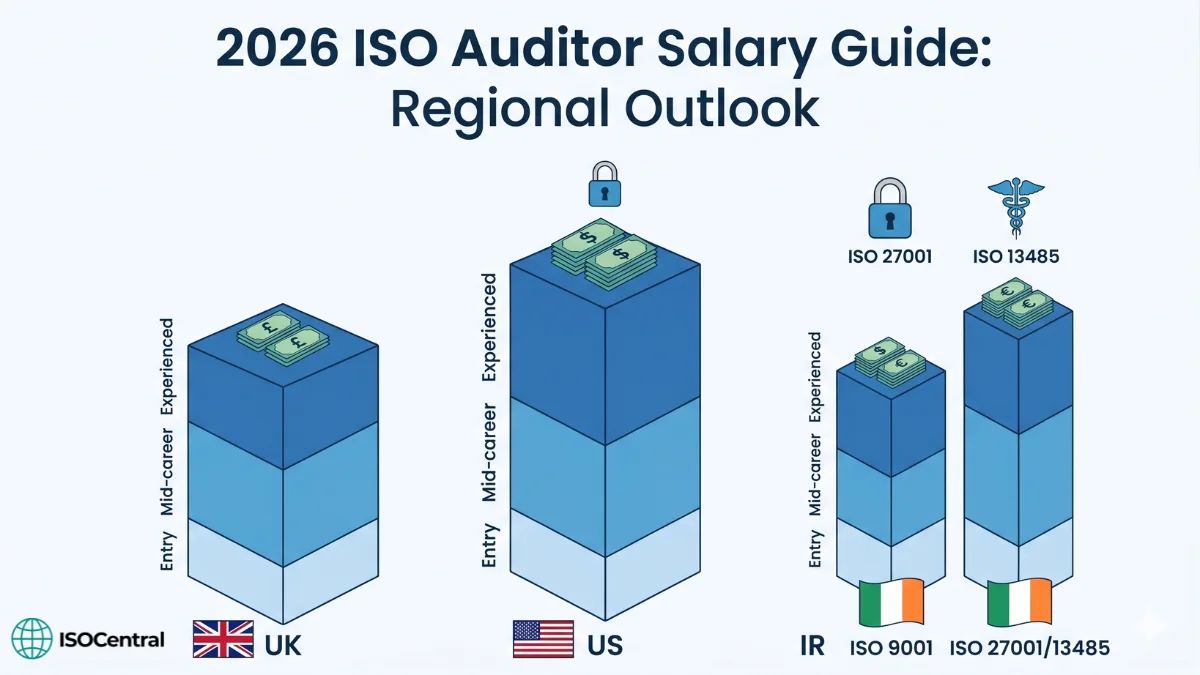
The average salary for an ISO 9001 Lead Auditor in the UK is approximately £48,460 per year, with a typical range of £39,753 to £60,573 for most practitioners.[1] Entry-level positions at certification bodies generally start at around £37,500, while the most experienced lead auditors earn £60,000 and above.[2]
Breaking this down by experience level:
- Entry level (0 to 3 years): £30,000 to £38,000[3]
- Mid-career (4 to 8 years): £38,000 to £52,000[4]
- Experienced (8 or more years): £52,000 to £65,000+[5]
ISO 27001 Lead Auditor Salaries (UK)
ISO 27001 specialists earn a meaningful premium over ISO 9001 counterparts, reflecting the overlap with cybersecurity roles where demand significantly outstrips supply. The average salary for ISO 27001 Lead Auditors in the UK is approximately £45,000 to £60,000 per year.[6] Senior practitioners and those combining ISO 27001 with complementary certifications such as CISA or CISM regularly exceed £65,000.[7]
ISO 14001 and ISO 45001 Lead Auditor Salaries (UK)
Environmental and health and safety lead auditors generally earn in line with ISO 9001 practitioners rather than at the ISO 27001 premium. Salaries typically range from £38,000 to £55,000, with specialist sectors such as energy, utilities, and oil and gas commanding higher rates.
ISO 13485 (Medical Devices) Salaries (UK)
ISO 13485 is a specialist qualification serving the medical device sector. Salaries for qualified lead auditors in this area reflect the complexity of the regulatory environment and the limited pool of qualified practitioners. Experienced ISO 13485 lead auditors and IVD auditors regularly achieve salaries of £55,000 to £70,000 and above.
Freelance and Contract Day Rates (UK)
Self-employed ISO lead auditors in the UK typically charge day rates in the range of £350 to £600 per day, depending on the standard, sector experience, and whether the work is sourced directly or through a certification body as a contracted auditor.[8] ISO 27001 and ISO 13485 specialists tend to command the upper end of this range.
At a utilization rate of around 180 to 200 chargeable days per year, this implies gross annual earnings of approximately £63,000 to £120,000 before business costs and tax. Contractors carry their own costs including professional indemnity insurance, CPD investment, and gaps between contracts, which should be factored into any comparison with salaried roles. Many independents also operate as ISO consultants alongside their auditing work to smooth income.
ISO Auditor Salaries in the United States
The US ISO auditing market is large and diverse, with demand driven by manufacturing, technology, healthcare, defense, and financial services. The major certification bodies operating in the US include BSI, Bureau Veritas, SGS, TUV Rheinland, Intertek, and a significant number of US-headquartered registrars.
ISO 9001 Lead Auditor Salaries (US)
The average ISO Lead Auditor salary in the United States is $77,304 as of April 2026, with a typical range of $71,636 to $84,127 for most practitioners.[9] Top earners at the 90th percentile make $90,339 per year.[10]
Breaking this down by experience level:
- Entry level (0 to 3 years): $51,000 to $66,000[11]
- Mid-career (4 to 8 years): $72,000 to $84,000[12]
- Experienced (8 or more years): $84,000 to $100,000+[13]
ISO 27001 Lead Auditor Salaries (US)
The premium for ISO 27001 expertise is particularly pronounced in the US, where the overlap with the broader cybersecurity talent market pushes compensation significantly higher. The average annual pay for an ISO 27001 Lead Auditor in the United States is $102,886, with most practitioners earning between $80,500 and $132,500.[14]
Practitioners who combine ISO 27001 lead auditor status with certifications such as CISA or CISSP regularly achieve total compensation well above $130,000.
Geographic Variation (US)
ISO auditor salaries vary significantly by state. The highest-paying states include:
- District of Columbia: $77,702[15]
- California: $77,407[16]
- Massachusetts: $76,375[17]
- Washington: $76,095[18]
The difference between the highest and lowest-paying states for ISO auditors is typically around 15 to 20%, somewhat less than in other professional disciplines given the portable, national nature of certification body employment.
Freelance and Contract Day Rates (US)
Freelance ISO auditors in the US typically bill approximately $1,200 to $1,400 per audit day.[19] At 120 to 150 billable days per year, this implies gross annual earnings of $144,000 to $210,000 for established independent auditors, though building a sustainable contract pipeline takes time and the work involves significant travel.
ISO Auditor Salaries in Ireland
Ireland's ISO auditing market is smaller in absolute terms than the UK or US but has particular strength in technology, pharmaceutical, medical device, and financial services sectors. The concentration of US multinational corporations in Dublin and the broader east coast creates demand for ISO 27001, ISO 13485, and ISO 9001 auditors with relevant sector experience.
General ISO Auditor Salaries (Ireland)
The average ISO auditor gross salary in Ireland is €60,419 per year, with entry-level practitioners earning approximately €42,915 and senior auditors with eight or more years of experience earning up to €74,763.[20]
Breaking this down by experience level:
- Entry level (0 to 3 years): €42,000 to €50,000[21]
- Mid-career (4 to 8 years): €50,000 to €65,000[22]
- Experienced (8 or more years): €65,000 to €80,000+[23]
Standard-Specific Premiums (Ireland)
As in the UK and US, ISO 27001 commands a premium in Ireland, particularly in the technology and financial services sectors concentrated in Dublin. ISO 13485 expertise is also highly valued given Ireland's large medical device manufacturing sector, which includes major employers such as Medtronic, Abbott, Stryker, and Boston Scientific.
Salary Comparison: UK, US, and Ireland
The table below summarizes typical mid-career salaries for ISO lead auditors by geography and standard. Figures represent approximate annual earnings for practitioners with four to eight years of experience in salaried employment.
| Standard | UK | US | Ireland |
|---|---|---|---|
| ISO 9001 | £42,000 to £52,000 | $72,000 to $84,000 | €50,000 to €65,000 |
| ISO 27001 | £50,000 to £65,000 | $90,000 to $120,000 | €58,000 to €75,000 |
| ISO 14001 / ISO 45001 | £40,000 to £52,000 | $70,000 to $82,000 | €48,000 to €63,000 |
| ISO 13485 | £50,000 to £68,000 | $80,000 to $100,000 | €60,000 to €80,000 |
Sources: Glassdoor, Payscale, Salary.com, Talent.com, SalaryExpert (2025/2026). Figures are approximate mid-career ranges for salaried practitioners. See references for individual citations.
How to Increase Your Earning Potential as an ISO Auditor
If you are looking to move up the salary scale, the following factors have the most consistent impact.
Add a second or third standard. Qualification across multiple standards makes you significantly more attractive to certification bodies and allows you to command higher day rates in contract work. The combination of ISO 9001 and ISO 27001 is particularly strong in the current market.
Develop sector depth. A lead auditor who deeply understands a specific industry (medical devices, aerospace, financial services, technology) can charge a premium because sector knowledge reduces the time certification bodies need to invest in client onboarding and reduces the risk of audit findings being challenged on technical grounds.
Pursue complementary certifications. For ISO 27001 specialists, adding CISA or CISM materially increases salary potential, particularly in the US where the cybersecurity talent market has inflated compensation across the board. For quality professionals, Chartered Quality Professional (CQP) status through the CQI is increasingly recognized by UK employers.
Move to contracting. The salary ceiling for employed auditors is considerably lower than for experienced independent contractors. Many auditors with eight or more years of experience find that moving to a self-employed or contract model significantly increases their annual earnings, provided they can build a reliable client base.
Target high-demand geographies. In the UK, London and the South East consistently pay above national averages. In the US, California, Washington DC, and the northeast corridor pay above national averages for most ISO auditing roles.
Looking for Your Next ISO Auditor Role?
Whether you are an experienced lead auditor benchmarking your market value or a newly qualified practitioner looking for your first role, our ISO Jobs board lists current vacancies from accredited certification bodies and consultancies across the UK, US, and Ireland.
You can also explore our directories of ISO registrars and ISO consultants to research potential employers, or use our ISO cost calculator to understand the wider economics of the certification market.
References
- Glassdoor. ISO 9001 Lead Auditor Salary, United Kingdom, March 2026. glassdoor.co.uk ↩
- Payscale. ISO Lead Auditor Salary, United Kingdom, 2026. payscale.com ↩
- Talent.com. Lead Auditor Salary, United Kingdom, 2026. uk.talent.com ↩
- Readynez. ISO 27001 Lead Auditor Salary: What to Expect, 2024. readynez.com ↩
- Salary.com. ISO Lead Auditor Salary, United States, April 2026. salary.com ↩
- Payscale. ISO Lead Auditor Salary, United States, 2025. payscale.com ↩
- ZipRecruiter. ISO 27001 Lead Auditor Salary, United States, February 2026. ziprecruiter.com ↩
- Salary.com. ISO Auditor Salary by State, United States, April 2026. salary.com ↩
- Konfirmity. ISO 27001 Audit Cost: A Practical Guide, 2026. konfirmity.com ↩
- SalaryExpert. ISO Auditor Salary, Ireland, 2025. salaryexpert.com ↩
- Glassdoor. Internal Auditor Salary, Dublin, Ireland, March 2026. glassdoor.com ↩
- IT Jobs Watch. ISO 27001 Lead Auditor Job Trends and Salaries, UK, six months to 31 March 2026. itjobswatch.co.uk ↩
- Quora / industry practitioners. How much does an ISO 9001 or AS9100 Lead Auditor earn per audit? Figures reflect market conditions up to May 2024. quora.com ↩
- ZipRecruiter. ISO 27001 Lead Auditor Salary, United States, February 2026. ziprecruiter.com ↩
- Salary.com. ISO Auditor Salary by State (District of Columbia), April 2026. salary.com ↩
- Salary.com. ISO Auditor Salary by State (California), April 2026. salary.com ↩
- Salary.com. ISO Auditor Salary by State (Massachusetts), April 2026. salary.com ↩
- Salary.com. ISO Auditor Salary by State (Washington), April 2026. salary.com ↩
- Quora / industry practitioners. How much does an ISO 9001 or AS9100 Lead Auditor earn per audit? 2024. quora.com ↩
- SalaryExpert. ISO Auditor Salary, Ireland, 2025. salaryexpert.com ↩
- SalaryExpert. ISO Auditor Entry Level Salary, Ireland, 2025. salaryexpert.com ↩
- Glassdoor. Internal Auditor Salary, Dublin, Ireland, March 2026. glassdoor.com ↩
- SalaryExpert. ISO Auditor Senior Level Salary, Ireland, 2025. salaryexpert.com ↩