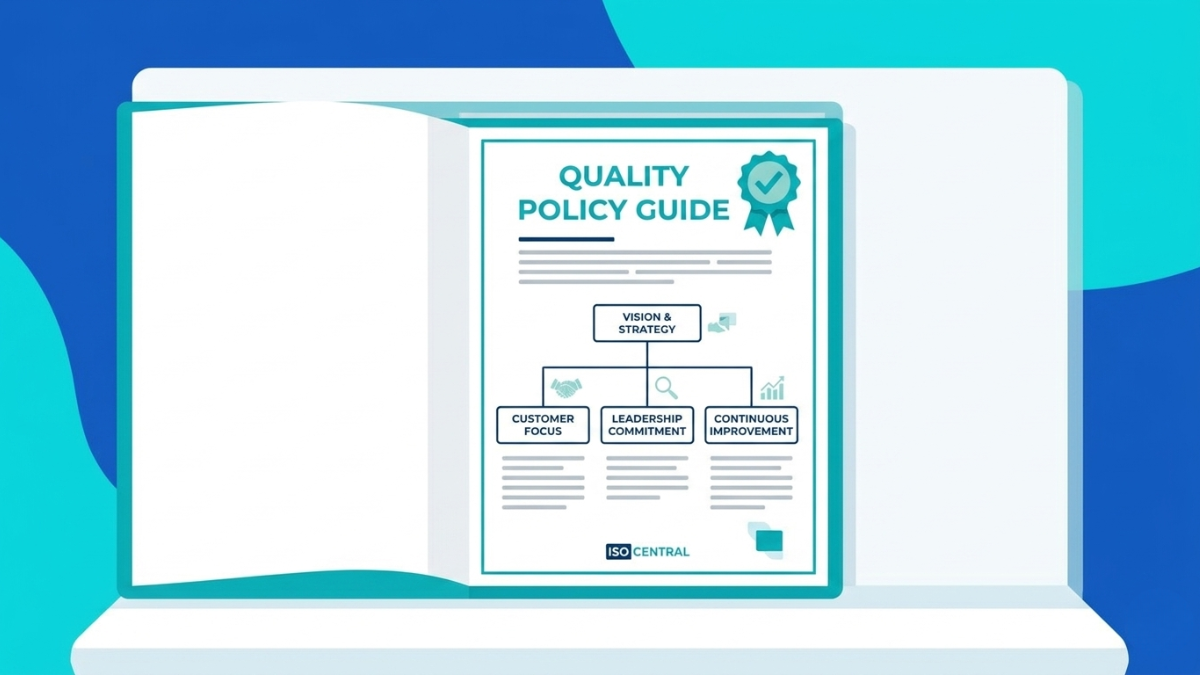
For any organization embarking on the journey toward ISO 9001 certification, the Quality Policy stands as one of the most critical documents in the entire Management System. It is not merely a piece of paper to be framed and hung in a lobby; it is the strategic heartbeat of the business. At ISOCentral, we recognize that SMEs often struggle to balance the technical requirements of ISO standards with the practical realities of running a business. This guide aims to demystify the concept of the Quality Policy, providing you with the tools to create a document that is both compliant and genuinely useful.
What is a Quality Policy?
In the simplest terms, a Quality Policy is a high-level statement from an organization's senior leadership that describes their commitment to quality. Within the framework of ISO 9001:2015, specifically Clause 5.2, the policy is defined as the "intentions and direction of an organization as formally expressed by its top management."
However, the definition goes deeper than a simple mission statement. A Quality Policy acts as the North Star for all quality related activities. It provides the necessary context for setting quality objectives, which are the measurable targets that prove the policy is being put into action. Without a clear policy, an organization lacks a unified sense of purpose regarding its products, services, and customer satisfaction goals.
To be effective, the policy must be appropriate to the purpose and context of the organization. A software development firm in San Francisco will have a vastly different Quality Policy than a precision engineering workshop in Manchester, England. The standard requires that the policy supports the organization's strategic direction, ensuring that quality is not an isolated department but an integral part of the business strategy.
Why are Quality Policies Important and When are they Required?
The importance of a Quality Policy cannot be overstated. From a purely administrative perspective, it is a mandatory requirement for ISO 9001 certification. An auditor will look for this document early in the assessment process. If a clear, communicated, and documented policy is missing, the organization will face a major nonconformity.
Beyond compliance, the policy serves several vital business functions. Firstly, it fosters a culture of excellence. When employees see a clear commitment from the top, it validates their own efforts to maintain high standards. Secondly, it builds customer trust. Sharing your Quality Policy with clients demonstrates that you have a structured approach to meeting their requirements and that you are committed to continual improvement.
When is it required? The requirement begins the moment you decide to implement a Quality Management System (QMS). It should be one of the first documents created, as it sets the stage for the rest of the system. It is also required whenever there is a significant shift in the company's operations, such as a merger, a new product line, or a change in ownership, to ensure that the quality direction remains relevant to the new reality.
How Do You Create a Quality Policy?
Creating a Quality Policy should be a collaborative effort led by senior management. It is not a task to be outsourced entirely to a consultant, as it must reflect the genuine values of the leadership. Follow these steps to draft a robust policy:
1. Understand Your Context
Before writing a single word, consider the internal and external factors that affect your business. Who are your stakeholders? What do your customers expect? What are the regulatory requirements in your industry? Your policy should be a reflection of these realities.
2. Align with Strategy
Ensure the policy supports your long-term business goals. If your strategy is to be the fastest provider in the market, your Quality Policy should reflect efficiency and speed. If your goal is to be the most innovative, the policy should mention cutting edge processes and creativity.
3. Include Mandatory Commitments
ISO 9001:2015 requires the policy to include specific commitments. You must state that you are committed to satisfying applicable requirements (which include customer, statutory, and regulatory needs). You must also explicitly state a commitment to the continual improvement of the Quality Management System.
4. Draft for Clarity
Avoid jargon and overly complex language. The policy needs to be understood by everyone, from the Managing Director to the newest apprentice. Use clear, active language. Instead of saying "Quality is sought by us," say "We are committed to delivering quality."
5. Review and Approve
Once drafted, the policy should be reviewed by key stakeholders to ensure it is accurate and achievable. Finally, it must be signed and dated by the highest level of management to demonstrate their "Top Management" commitment as required by Clause 5.1.
The Quality Policy Statement
The Quality Policy Statement is the core message of the document. While the full policy might include some introductory context, the statement is the "meat" of the document. It is often condensed into a few powerful paragraphs that can be easily displayed on posters, websites, or business cards.
A good statement is memorable. It should balance professional gravity with the unique personality of the business. It serves as a promise to the customer and a mandate to the staff. It is the public face of your quality system.
Quality Policy Sample and Example
To help you visualize what this looks like in practice, here is a simple Quality Policy example for a fictional SME called "Precision Components Ltd."
Precision Components Ltd - Quality Policy
At Precision Components Ltd, our mission is to provide high quality machined parts that exceed the expectations of our clients in the aerospace and automotive sectors.
We are committed to:
- Satisfying all applicable customer, statutory, and regulatory requirements.
- Maintaining an ISO 9001 compliant Quality Management System to ensure consistency and reliability.
- Investing in the latest technology and staff training to remain at the forefront of our industry.
- Reviewing our quality objectives regularly to drive business growth.
- Continuously improving our processes to enhance efficiency and reduce waste.
This policy is communicated to all staff and is made available to interested parties via our company website. It is reviewed annually to ensure its ongoing suitability.
Signed: J. Smith, Managing Director
Date: 14th April 2026
Why this Example Works
This sample is effective because it mentions the specific industry (aerospace and automotive), fulfilling the "context" requirement. It includes the mandatory commitments to satisfy requirements and to improve continually. Finally, it mentions how the policy is communicated and reviewed, showing a comprehensive understanding of the ISO 9001 standard.
How Often Should Quality Policies be Reviewed?
A Quality Policy is not a "set it and forget it" document. ISO 9001 requires that the policy is maintained as documented information and is reviewed for "continuing suitability."
Standard practice is to review the policy at least once a year. This usually happens during the Management Review Meeting. During this session, leadership should ask: Is this still who we are? Have our goals changed? Has the market shifted? If the answer is yes, the policy should be updated.
Furthermore, an ad hoc review should occur if the business undergoes a major change. For instance, if a company that previously only manufactured goods starts offering installation services, the Quality Policy must be updated to reflect this new scope. Keeping the policy current ensures that it remains a living document that truly guides the organization.
Communicating the Policy
Having a brilliant Quality Policy is useless if nobody knows it exists. ISO 9001 Clause 5.2.2 is very clear: the policy must be available and maintained as documented information, it must be communicated, understood, and applied within the organization, and it must be available to relevant interested parties as appropriate.
Creative ways to communicate the policy include:
- Including it in the new starter induction pack.
- Displaying it prominently in communal areas like break rooms or the reception.
- Adding the core statement to the footer of company emails.
- Discussing the policy during regular team briefings or "toolbox talks."
- Publishing the policy on the company website for suppliers and customers to view.
How ISOCentral Can Help
The Quality Policy is the cornerstone of any successful Quality Management System. By following the guidance provided you can move beyond mere compliance and create a document that provides genuine strategic value. Remember that the best policies are those that are simple, honest, and consistently applied. It is your promise of quality to the world, and it should be treated with the importance it deserves.
Our ISO 9001 page provides a lot of useful information, including a link to where you can purchase a copy of the standard. Of course, if you get stuck, you can get a free quote from verified experts within our consultant directory. You might also choose to use a dedicated software solution that has been designed specifically to help you achieve certification. Our software directory is ideal for helping you explore the options. And when you are ready to move towards certification, our directory of registrars and certification bodies can help you on your way. Alternatively, to speed up the process and to avoid you having to repeat yourself, why not request a free quote through our website and we will do the hard work for you?