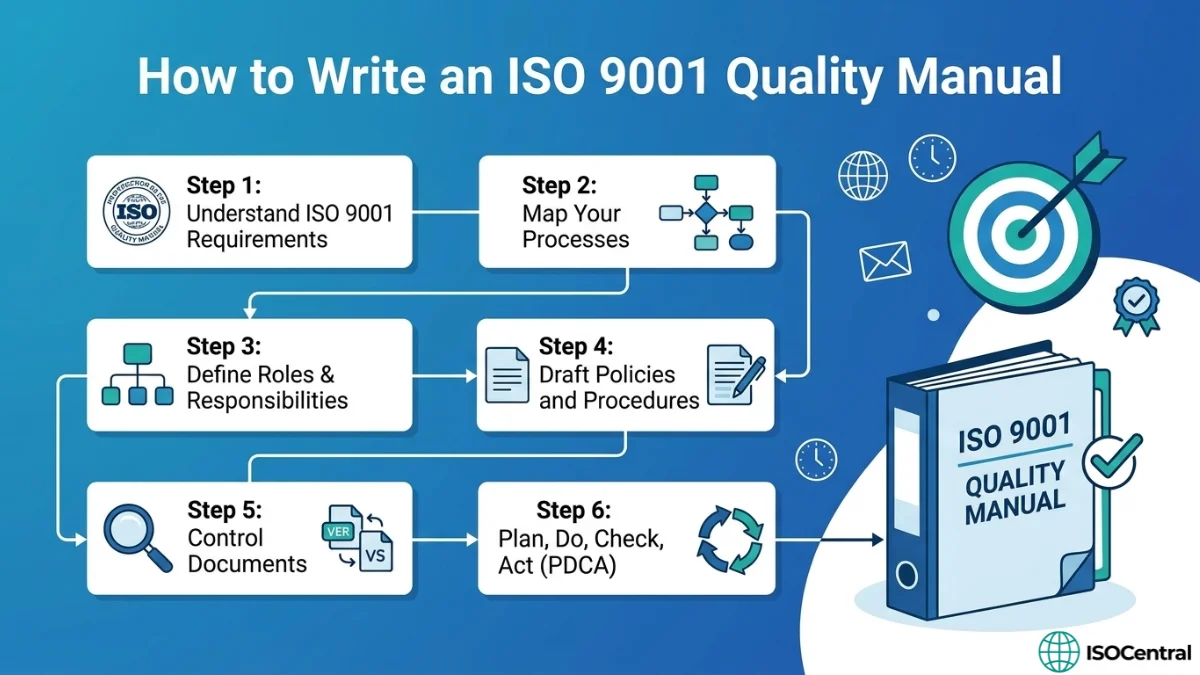
If you have been researching ISO 9001 certification, you have probably come across the term "quality manual" and wondered whether you need to write one, what it should contain, and how long it needs to be. The short answer is that ISO 9001:2015 does not actually require you to produce a formal quality manual. The requirement was removed in the 2015 revision. But many businesses still produce one, and for good reason: a well-written quality manual is a genuinely useful document that helps your team understand the management system, demonstrates your QMS scope and structure to customers and auditors, and provides a navigable overview of how your organization works.
This guide explains what a quality manual is, whether you need one, what it should contain if you choose to produce it, and how to write one that is concise and genuinely useful rather than a generic document that nobody reads.
Do You Need a Quality Manual for ISO 9001?
No. ISO 9001:2015 Clause 7.5 requires you to maintain and retain documented information, but it does not prescribe a quality manual as a mandatory document. This was a deliberate change from ISO 9001:2008, which required a manual as a specific deliverable.
However, many certification bodies and customers still ask to see a quality manual during audits and supplier assessments. It provides a convenient single document that describes the scope of your QMS, references your key processes and procedures, and explains how your system meets the requirements of the standard. For a first-time certification, producing a quality manual is strongly recommended even though it is not mandatory.
The 2015 change explained
ISO 9001:2008 required organizations to produce a documented quality manual as a mandatory deliverable. The 2015 revision removed this requirement as part of a broader move toward flexible, risk-based documentation. Your organization can choose the format, extent, and media of its documented information based on what is appropriate for its context and complexity.
What a Quality Manual Should Contain
There is no prescribed format, but a useful quality manual for an SME typically covers the following areas.
1. Organizational overview
A brief description of what your organization does, the markets it serves, and the context in which it operates. This does not need to be lengthy: two or three paragraphs is sufficient for most small businesses.
2. Scope of the QMS
This is one of the most important sections. It defines which parts of your organization, which locations, and which products or services are covered by the QMS. If you have excluded any clause of ISO 9001 (for example, Clause 8.3 on design and development may not apply to a business that manufactures to customer specifications rather than developing its own designs), this is where you state and justify those exclusions.
3. Quality policy
Include your quality policy in the manual, or reference the standalone document. The policy must be appropriate to the purpose of the organization, provide a framework for setting quality objectives, and commit to meeting requirements and continually improving the QMS.
4. Organizational structure and responsibilities
A brief explanation of how responsibilities for the QMS are allocated. This can include an organization chart or a responsibility matrix. It does not need to map every role in the business: focus on QMS-relevant responsibilities.
5. Process descriptions or references
Either a description of your key processes and how they interact, or references to where the detailed process documentation can be found. A process map or turtle diagram is a useful addition here. Hartley Precision Engineering, a Sheffield-based precision manufacturer, includes a one-page process interaction diagram in their quality manual showing how sales, production, quality control, delivery, and supplier management processes connect.
6. References to documented procedures
A document register or index listing the key procedures, work instructions, and forms that support the QMS, with version numbers and locations. This gives auditors and new staff a clear map of where to find the system documentation.
7. Clause cross-reference matrix (optional but useful)
A table showing how each clause of ISO 9001:2015 is addressed within your documented system. This is particularly helpful for first-time audits: it demonstrates that you have consciously mapped your system against the standard.
ISO 9001:2015 Clause | Where addressed in our QMS |
|---|---|
4.1 Understanding the organization | Context analysis document, management review minutes |
4.2 Interested parties | Interested party register (Form QMS-04) |
4.3 Scope of the QMS | Section 2 of this quality manual |
5.1 Leadership commitment | Quality policy; management review procedure |
6.1 Risks and opportunities | Risk register (QMS-06); management review |
7.5 Documented information | Document control procedure (QMS-08) |
8.4 External providers | Approved supplier list; supplier audit procedure |
9.2 Internal audit | Internal audit procedure (QMS-11); audit schedule |
10.2 Corrective action | Corrective action procedure (QMS-12); CAR log |
How Long Should a Quality Manual Be?
For most SMEs, a quality manual of 10 to 20 pages is entirely appropriate. The key principle from ISO 9001:2015 is that documented information should be appropriate for the size of the organization and the complexity of its processes. A 12-person professional services firm does not need a 50-page manual. A 200-person manufacturer with multiple production lines might justifiably produce a longer document, but length is never a proxy for quality.
The documents that fail audits are not the short ones: they are the ones that describe an idealized system that does not match how the organization actually operates. A concise, accurate manual is always more valuable than a comprehensive one that nobody follows.
Common Quality Manual Mistakes to Avoid
Copying a generic template without adapting it to your organization: auditors can identify generic content immediately, and it raises questions about how well you actually understand your own system.
Describing processes in aspirational terms rather than how they actually work: your manual should reflect current practice, not best intentions.
Including excessive detail that belongs in procedures rather than the manual: the manual provides the overview; procedures contain the step-by-step instructions.
Failing to control the document: your quality manual must itself be subject to your document control process with a version number, approval signature, and review date.
Writing it as a one-person exercise: involve the people who manage the processes being described to ensure accuracy.
What ISO 9001:2026 Means for Your Quality Manual
If you are writing or updating a quality manual now, it is worth understanding how ISO 9001:2026 is likely to affect it. The revision is expected to be published in September 2026, with a three-year transition period running to approximately September 2029. First certificates to the new standard are not expected until around mid-2027, after certification bodies have been trained and accredited.
The good news is that the revision is evolutionary rather than revolutionary. The core structure of the standard is preserved, and organizations already certified to ISO 9001:2015 will not need to rebuild their management systems. But several changes are directly relevant to quality manual content, and writing with them in mind now will reduce the revision work later.
Changes that will affect your quality manual
Quality culture and ethical behavior: ISO 9001:2026 Clause 5.1.1 will explicitly require top management to promote and demonstrate a quality culture and ethical behavior. If your quality manual describes leadership responsibilities, this is a new dimension to reflect. Consider adding a brief statement about the organization's approach to quality culture alongside the existing policy and objectives framing.
Climate change in your context analysis: the revision formally integrates the 2024 climate amendment into Clause 4.1, requiring consideration of climate change as a factor in your organizational context. If your quality manual includes a context analysis section or references your approach to Clause 4.1, this will need a brief addition confirming that climate-related factors are considered.
Terminology changes to documented information: the terms "maintain" and "retain" as applied to documented information are expected to change in the 2026 revision, with clearer and more consistent language replacing them. The practical impact for most organizations is minor, but your document control procedure and any references in your quality manual will need a terminology review during transition.
Stronger emphasis on risk analysis: the 2026 revision requires risks and opportunities to be analyzed and evaluated, not merely identified and listed. If your quality manual describes your approach to risk management, it should reflect this analytical requirement rather than a simple identification exercise.
Knowledge management: Clause 7.1.6 on organizational knowledge is expected to be strengthened. If your quality manual references how the organization captures and shares knowledge, consider whether that description is sufficiently substantive.
What to do now
If you are implementing ISO 9001 for the first time in 2025 or 2026, implement to the ISO 9001:2015 standard. Certification bodies are not yet issuing certificates to the 2026 version, and the 2015 standard remains fully current. The transition period gives you until 2029 to update your system.
If you are writing a quality manual now, design it with the 2026 changes in mind where they are relevant. Adding a sentence to your leadership section about quality culture, and confirming climate change is considered in your context analysis, costs nothing now and reduces the transition effort later. This is particularly practical guidance for businesses building a new system in 2026.
Format and Maintenance
A quality manual can be produced in any format: Word document, PDF, SharePoint page, or within compliance software. What matters is that it is controlled (version-numbered and approved), accessible to the people who need it, and reviewed and updated when the management system changes significantly.
Build a review into your annual management review meeting: confirm that the manual still accurately reflects the scope and structure of your QMS, and update it if significant changes have occurred.
Useful Resources
Purchase ISO 9001 QMS templates to accelerate your documentation.
Find ISO 9001 consultants who can help draft your quality manual.
About The Author
Nicole Webb is an ISO compliance specialist with extensive experience in ISO management systems, accreditation and internal auditing, providing a strong foundation for writing practical, expert-led articles on ISO topics. She has managed accredited management systems and supported Global compliance teams across ISO 9001, ISO 14001, ISO 45001, ISO 22301, ISO 27001 and ISO 13485, giving her a broad, cross-standard perspective that informs her writing. She now runs ISOLiteBites, an ISO-focused training company delivering both e-learning courses and bespoke training for businesses of all sizes.