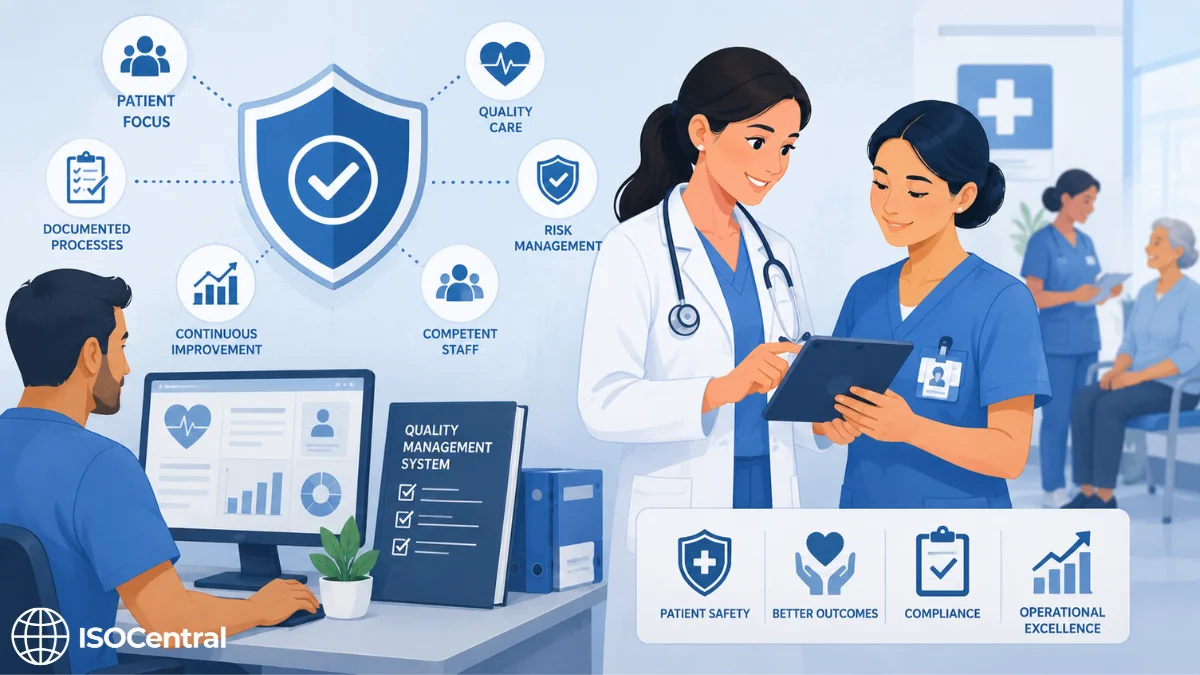
ISO 9001 is the world's most widely implemented quality management standard, and healthcare is one of its most natural applications. The standard's core principles - customer focus, risk-based thinking, process management, and continual improvement - map directly onto the challenges that medical practices, clinics, community health services, and allied health providers face every day.
This guide is written for healthcare business owners, practice managers, and clinical administrators considering ISO 9001 certification. It explains what the standard requires in a healthcare context, how it applies to different types of health service, how it relates to other healthcare-specific standards, and what certification typically costs and takes.
Why Healthcare Organisations Pursue ISO 9001
Healthcare organisations pursue ISO 9001 certification for three broad reasons.
Procurement and commissioning requirements: NHS contracts, private healthcare networks, and government health agencies increasingly require or prefer suppliers with ISO 9001 certification. For occupational health providers, physiotherapy chains, dental groups, and healthcare technology businesses, certification is often a commercial prerequisite.
Operational improvement: ISO 9001 provides a structured framework for managing clinical and administrative processes, handling complaints, identifying and managing risks, and driving continuous improvement. For practices that have grown rapidly or operate across multiple sites, the management discipline the standard requires can bring order to complex operations.
Patient satisfaction and trust: In a sector where reputation is paramount, certification provides patients, referrers, and commissioners with independent evidence that the organisation has a verified quality management system. It signals that quality is managed systematically rather than depending on the judgment of individual clinicians.
ISO 9001 is a general quality management standard, not a healthcare-specific regulatory framework. It does not replace Care Quality Commission (CQC) registration in England, NHS quality standards, or professional regulatory requirements. It sits alongside them, providing a management system that supports compliance with those requirements rather than substituting for it.
How ISO 9001 Applies in Healthcare Contexts
The standard uses generic language because it is designed to apply across all sectors. In a healthcare context, the key terms translate as follows.
ISO 9001 term | In a healthcare context | Example |
|---|---|---|
Customer | Patient, service user, commissioner, referrer, or insurer | A GP practice's customers include patients and the ICB commissioning the service |
Product / service | Clinical care, diagnostic service, health technology, or support service | A physiotherapy practice's product is the treatment delivered to patients |
Customer requirements | Clinical outcomes, patient experience, waiting times, reporting standards | An occupational health provider's requirements include fitness-for-work report turnaround time |
Process | Clinical pathway, administrative workflow, or support process | Patient registration, appointment booking, triage, consultation, referral, discharge |
Nonconformity | A failure to meet a defined standard, protocol, or patient expectation | A missed appointment, a delayed referral, or a reported patient complaint |
Corrective action | Root cause investigation and systematic remedy | Reviewing a referral pathway after a pattern of delays is identified |
Clinical vs Administrative Scope
A common question for healthcare organisations is whether the QMS scope should include only clinical processes or only administrative ones. Most healthcare organisations that certify to ISO 9001 include both clinical and administrative processes in scope. A QMS that covers patient registration, appointment management, and billing but excludes clinical care is unlikely to drive significant improvement in patient outcomes or satisfaction.
The standard does not require organisations to make clinical judgments or prescribe clinical protocols: it requires them to manage their processes systematically. Defining the expected standard of care for a clinical pathway, monitoring whether that standard is being met, and acting when it is not are all management activities that ISO 9001 applies to directly.
Key ISO 9001 Requirements in a Healthcare Context
The following areas of ISO 9001 are most significant for healthcare organisations.
Risk Management (Clause 6.1)
ISO 9001 requires organisations to identify and address risks that could affect the achievement of quality objectives. In healthcare, this maps naturally onto clinical risk assessment, patient safety incident management, and infection control. A healthcare organisation implementing ISO 9001 should maintain a risk register that includes both clinical risks (for example, risk of medication error, risk of delayed diagnosis, risk of healthcare-associated infection) and operational risks (key person dependency, IT system failure, regulatory change).
Risk-based thinking also connects to Clause 8.4 on the control of externally provided processes: for healthcare organisations that work with external laboratories, radiology services, or locum clinical staff, this clause requires documented processes for qualifying, monitoring, and managing those external providers.
Customer Focus and Patient Satisfaction (Clauses 5.1.2 and 9.1.2)
Patient satisfaction monitoring is a natural fit for ISO 9001 Clause 9.1.2, which requires organisations to monitor customer perceptions. Healthcare organisations already collect patient feedback through Friends and Family Test responses, NHS patient surveys, Google reviews, and formal complaints. The standard requires that this feedback is analysed systematically, that trends are identified, and that the data feeds into improvement decisions at management review.
The distinction the standard draws between customer requirements and customer satisfaction is particularly relevant in healthcare: a patient's stated preferences may differ from their clinical requirements. The QMS needs to address both and document how conflicts between the two are managed. For a deeper look at this, see our guide to measuring patient satisfaction to Clause 9.1.2.
Documented Processes and Controlled Information (Clause 7.5)
Healthcare organisations typically have extensive documented protocols, clinical guidelines, and administrative procedures. ISO 9001 does not require you to document everything from scratch: it requires that the documents you have are controlled, version-managed, accessible to the people who need them, and reviewed when processes change.
For multi-site practices or organisations with high staff turnover, this clause often surfaces the most immediate operational benefits of ISO 9001 implementation. A controlled document management system ensures that all clinical staff are working from current protocols rather than outdated versions.
Competence and Training (Clause 7.2)
ISO 9001 requires organisations to determine the competence required for staff whose work affects quality, to ensure that training and development maintain that competence, and to retain evidence of competence as documented information. In healthcare, this maps directly onto clinical professional development, revalidation, mandatory training compliance, and supervision records.
A well-implemented QMS connects the competence management requirements of ISO 9001 to existing CPD and revalidation processes, reducing duplication rather than creating a parallel compliance burden.
Complaint Management and Corrective Action (Clauses 8.2.1 and 10.2)
Patient complaints are a mandatory input to the ISO 9001 management system. Clause 8.2.1 requires communication processes for handling complaints. Clause 10.2 requires corrective actions that address root causes when nonconformities occur. In healthcare, a formal patient complaint should trigger not just a response to the individual patient but a structured investigation of whether the underlying process has a systemic failure that needs addressing.
For organisations subject to Duty of Candour obligations, the structured investigation approach in ISO 9001 provides a natural framework for meeting those obligations.
ISO 9001 and Other Healthcare Standards
ISO 9001 is one of several quality and compliance frameworks relevant to healthcare organisations. Understanding how it relates to the others helps organisations avoid duplication and plan their compliance approach efficiently.
ISO 9001 vs ISO 13485: Understanding the Difference
ISO 13485 is the quality management standard specifically for organisations involved in the design, manufacture, installation, or servicing of medical devices. It is built on the same principles as ISO 9001 but includes additional requirements specific to medical device regulatory compliance.
If your organisation manufactures, supplies, or services medical devices, ISO 13485 is the relevant standard. If your organisation provides healthcare services (clinical care, therapy, diagnostics, occupational health), ISO 9001 is the appropriate starting point.
Some healthcare technology businesses hold both ISO 9001 for their service delivery operations and ISO 13485 for their medical device product lines.
ISO 7101: The Healthcare-Specific Quality Standard
ISO 7101:2023 is the first international standard specifically for quality management in healthcare organisations. Published in 2023, it builds on ISO 9001 principles but adds healthcare-specific requirements, including patient-centred care, equity, compassion, and the unique governance challenges of health services.
ISO 7101 is currently less widely adopted than ISO 9001, and certification is not yet as widely available. For most healthcare SMEs in 2026, ISO 9001 remains the more commercially recognised and practically accessible choice.
CQC Registration and ISO 9001
For healthcare providers in England registered with the Care Quality Commission, ISO 9001 sits alongside CQC compliance rather than substituting for it. The CQC's five key questions (safe, effective, caring, responsive, well-led) overlap significantly with the principles of ISO 9001, particularly in the well-led domain. Organisations that implement ISO 9001 effectively often find that the evidence they generate for audits also satisfies much of what CQC inspectors look for.
ISO 9001 certification does not grant any formal recognition from the CQC, but it demonstrates to inspectors that quality management is structured, systematic, and continuously reviewed, which aligns with what the well-led framework expects.
What are the ISO 9001 Certification Costs for a Healthcare SME
Costs vary depending on the size of the organisation, the number of sites, and whether existing documented processes can be adapted or need to be built from scratch. For a single-site healthcare practice or clinic with under 30 staff, the following ranges are typical.
Gap analysis and implementation support: £3,000 to £10,000 depending on the complexity of processes and the depth of consultant involvement. Organisations with existing quality policies, complaint handling procedures, and documented clinical protocols will typically be at the lower end.
Certification body fees for Stage 1 and Stage 2 audits: £3,000 to £7,000 for initial certification. Annual surveillance audits thereafter run approximately 30 to 40 per cent of the initial audit fee.
Internal staff time: typically 0.25 to 0.5 FTE of a practice manager or compliance lead over the implementation period. Connecting ISO 9001 requirements to existing CQC compliance activities, revalidation processes, and patient feedback systems reduces this significantly.
The implementation timeline for a single-site practice from gap analysis to certification is typically six to 12 months. Multi-site organisations or those with more complex clinical service lines should allow longer.
About The Author
Nicole Webb is an ISO compliance specialist with extensive experience in ISO management systems, accreditation and internal auditing, providing a strong foundation for writing practical, expert-led articles on ISO topics. She has managed accredited management systems and supported Global compliance teams across ISO 9001, ISO 14001, ISO 45001, ISO 22301, ISO 27001 and ISO 13485, giving her a broad, cross-standard perspective that informs her writing. She now runs ISOLiteBites, an ISO-focused training company delivering both e-learning courses and bespoke training for businesses of all sizes.