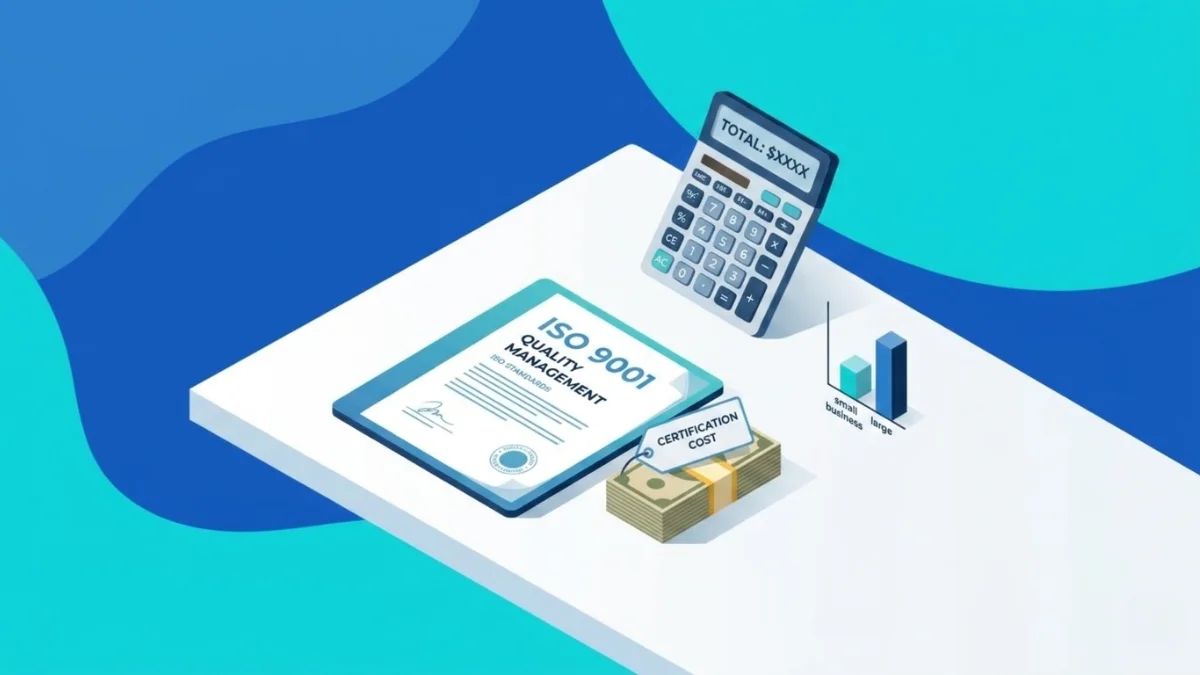
ISO 9001 certification costs vary more than many people expect, and the figures you find online are often incomplete. They tend to focus on the certification body's audit fees while leaving out the higher and less predictable costs: the time your team will invest, the documentation that needs to be produced, and the ongoing expense of maintaining the system year after year.
This guide breaks down every category of cost involved in ISO 9001 certification, gives realistic ranges based on business size, and explains the key decisions that will most affect your total spend.
The Two Categories of ISO 9001 Cost
Before looking at specific figures, it helps to understand that ISO 9001 costs fall into two distinct buckets: what you pay your certification body, and what you invest in getting your management system ready. Most businesses focus on the first and underestimate the second.
Category 1: Certification body fees
These are the fees charged by your chosen registrar (also called a certification body or CB) for auditing your management system and issuing your certificate. They include the following.
Stage 1 audit: a desk-based review of your documented system, typically half a day to one day
Stage 2 audit: the full certification assessment, conducted on-site, typically one to three days, depending on your organisation's size
Annual surveillance audits: shorter audits in years one and two of your three-year certificate cycle
Recertification audit: a full re-assessment at the end of the three-year cycle
Certification body fees are calculated primarily on the basis of employee headcount, the number of sites you operate from, and the complexity of your operations. Some registrars publish their pricing methodology publicly, though they will not always publish exact prices without a quote request.
Category 2: Implementation costs
These cover everything involved in building and maintaining your Quality Management System (QMS). They include consultant fees if you use external support, staff time invested in implementation and ongoing management, software or tools if you choose to use them, and the cost of purchasing the official standard document.
Implementation costs are almost always higher than certification body fees for a first-time certification, but they are also the costs over which you have the most control.
Indicative Cost Ranges by Business Size
The figures below are indicative ranges based on typical first-time certification projects. They assume a single-site operation with a straightforward scope. Actual costs will vary based on your sector, the complexity of your processes, and the certification body you choose.
Business size | Typical total first-certification cost |
1 to 10 employees | £3,000 to £6,000 (GBP) / $4,000 to $8,000 (USD) |
10 to 50 employees | £5,000 to £12,000 (GBP) / $6,500 to $16,000 (USD) |
50 to 150 employees | £10,000 to £25,000 (GBP) / $13,000 to $32,000 (USD) |
Ongoing annual cost (all sizes) | £1,500 to £4,000 (GBP) / $2,000 to $5,000 (USD) |
Note: these ranges include certification body fees and a mid-range consultant engagement. Self-implementation without a consultant will be significantly less expensive in direct costs but more expensive in staff time.
Consultant Fees: the Biggest Variable
Whether to use an ISO consultant is the single decision with the greatest impact on your total cost. The options broadly fall into three approaches.
1. Full-service consultant
A consultant manages the entire implementation: gap analysis, documentation, staff briefings, internal audit, management review preparation, and support through the certification audit itself. This is the fastest route to certification and the lowest risk of audit failure, but it carries the highest direct cost. Expect to pay £4,000 to £10,000 for a small to mid-sized business in the UK, or the equivalent in USD or EUR.
Tip: look out for ISO consultants who offer 100% certification guarantees and/or those who offer monthly instalments for the build and ongoing maintenance of your management system. This is often the best solution for smaller companies that do not have the resources to build and maintain their system in-house.
2. Targeted consultant support
Many businesses use a consultant for the gap analysis and key documentation only, then manage the ongoing implementation in-house. This cuts consultant fees by 40 to 60 per cent while retaining the benefit of expert input at the most critical stages.
3. Self-implementation
Businesses with an experienced quality professional in-house, or a team member with prior ISO exposure, can implement without a consultant. The direct cost saving is substantial, but self-implementation takes longer, requires more internal time, and carries a higher risk of gaps being missed ahead of the certification audit. It is a viable route, but not one to take lightly.
Tip: Rather than starting from scratch, consider purchasing QMS templates. They can cost anywhere between £100 and £1,000, but the time saved is often well worth the investment.
Staff Time: the Cost Most Businesses Miss
Internal staff time is the most commonly overlooked cost in ISO 9001 certification, and often the largest single component of the total spend. Consider what is actually involved.
A project lead will typically spend 20 to 60 hours on implementation for a small business, and significantly more for a larger one
Process owners across the business will each need time to review and sign off their documented procedures
All staff need a briefing on the management system before the certification audit
An internal auditor needs to be trained and given time to conduct the pre-certification internal audit
If your internal project lead earns £40,000 per year and spends 40 hours on the implementation, that alone represents approximately £800 in salary cost before any other expenses are counted. For larger organisations with more complex systems, the internal time investment can easily exceed the consultant fees.
Ongoing Maintenance Costs
ISO 9001 certification is not a one-off expense. Maintaining your certificate over the three-year cycle involves the following recurring costs.
Year 1 surveillance audit: typically 30 to 40 per cent of the initial certification audit fee
Year 2 surveillance audit: similar to year one
Year 3 recertification audit: comparable to the original Stage 2 audit
Ongoing internal audit time: at least one internal audit cycle per year
Management review meeting time: at least once per year, involving senior leadership
Corrective action management: time to investigate and address nonconformities
For most SMEs, the ongoing annual cost of maintaining ISO 9001 certification is significantly lower than the initial implementation cost, typically falling in the range of £1,500 to £4,000 per year, including certification body fees.
Other Costs to Factor In
Official standard document: ISO 9001:2015 costs approximately £130 (for Members) from BSI in the UK or $235 (fro Members) from ANSI in the US. You can also purchase from ISO itself. This is a one-off purchase.
ISO compliance software: optional but useful for document control and audit management. Entry-level tools start at around £50 to £150 per month
Internal auditor training: if training an internal auditor from scratch, expect to spend £300 to £1,500 on a reputable course
Travel and expenses: some certification bodies charge travel expenses for on-site audits, particularly outside major urban areas. This can mount up so it's worth checking the T&Cs.
Annual Registration Fees: Some certification bodies charge additional fees for maintaining your certification.
Is There Financial Support Available?
In the UK, some local enterprise partnerships and Growth Hubs have historically offered grants or subsidised consultancy for SMEs pursuing ISO certification, though availability varies significantly by region and changes over time. It is worth checking with your local business support service before beginning.
In Ireland, Enterprise Ireland offers support schemes for qualifying businesses that may cover elements of certification costs. In the US, the Small Business Administration provides general business development resources, though there is no federal grant programme specifically for ISO certification.
Getting an Accurate Quote
The most reliable way to establish your actual certification costs is to request quotes from at least two or three accredited certification bodies. Most will provide a quote based on your employee headcount, scope of certification, and sector. Comparing quotes from different registrars is straightforward and can reveal meaningful differences in fee structures.
For a tailored estimate of your full certification cost including implementation, use our ISO Certification Cost Calculator.