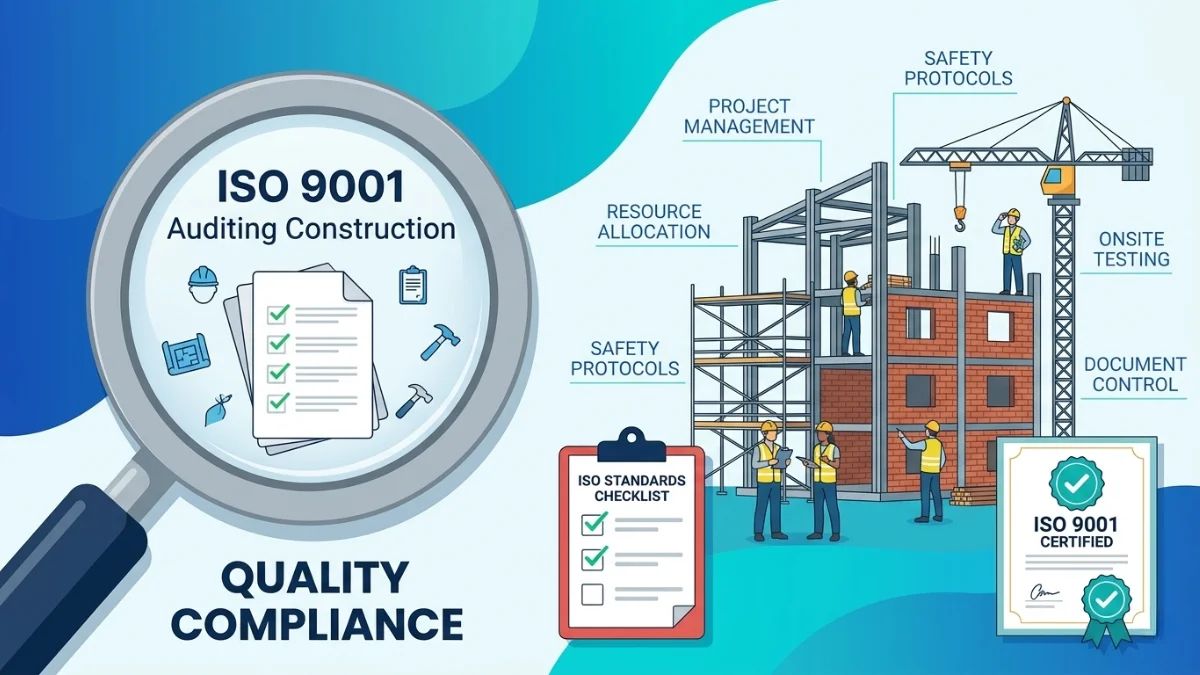
ISO 9001 is widely held in the construction sector, and for good reason. Construction companies operate in an environment where quality failures carry serious consequences: defects, rework, contract disputes, and reputational damage are all significantly more costly in construction than in many other sectors. The standard provides a systematic framework for managing the processes that determine whether a project is delivered to the right quality, on time, and within budget.
This guide explains how ISO 9001 applies specifically to construction companies: what the standard requires in a construction context, why clients and main contractors increasingly expect it, and what implementation looks like for a typical SME in the sector.
To help explain the requirements we use a fictitious example company throughout: Bridgewater Groundworks Ltd, a 22-person civil engineering contractor based in Stoke-on-Trent.
Why Construction Companies Pursue ISO 9001
Supply chain and tender requirements
The most common driver is commercial. Across the UK, US and Ireland, ISO 9001 certification has become a standard pre-qualification requirement for construction supply chains. The Constructionline, CHAS, and SafeContractor schemes used extensively in the UK all either require or give preference to ISO 9001 certified suppliers. Public sector frameworks, main contractor approved supplier lists, and government procurement portals increasingly treat it as a threshold requirement rather than a differentiator.
For sub-contractors and specialist contractors in particular, the inability to demonstrate ISO 9001 certification can effectively exclude a business from tendering for work above a certain value. Many companies in the sector certify not because they choose to, but because not certifying would mean losing access to significant portions of their addressable market.
Risk management and defect reduction
Beyond the commercial case, ISO 9001 provides real operational value in a sector where poor quality control has immediate and sometimes irreversible consequences. The standard's requirements around process control, supplier management, and nonconformity handling are directly applicable to construction quality challenges: defective materials from suppliers, subcontractor work that does not meet specification, and handover disputes with clients.
Companies that implement ISO 9001 substantively, rather than as a paperwork exercise, typically report reductions in defect rates and rework costs. In construction, where rework can represent three to five per cent of total project costs, even a modest reduction in defect rates has a meaningful financial return.
Integration with other management standards
ISO 9001 is frequently implemented alongside ISO 45001 (occupational health and safety) and ISO 14001 (environmental management) in construction businesses. The three standards share a common structure (Annex SL, the High-Level Structure, or HLS) which means their management system requirements can be integrated into a single Integrated Management System (IMS), reducing duplication of documentation and audit effort. Many construction companies pursue all three simultaneously for this reason.
How ISO 9001 Applies in a Construction Context
ISO 9001:2015 is a generic standard, written to apply to any organisation in any sector. This means some interpretation is required to understand what its clauses actually demand from a construction business. The table below maps the key requirements to their construction equivalents.
| Clause | Standard requirement | What this looks like in construction |
|---|---|---|
| 4.1 / 4.2 | Context and interested parties | Clients, main contractors, subcontractors, regulators (HSE, Environment Agency, planning authorities), local communities near site |
| 4.3 | Scope of the QMS | Define which project types and services are in scope. Groundworks contractor may exclude design services if these are not provided |
| 6.1 | Risks and opportunities | Risk register covering project delivery risks: ground conditions, weather, supply chain delays, design changes, H&S incidents |
| 6.2 | Quality objectives | Measurable targets: defect rate per project, client satisfaction score, rework as % of turnover, snagging items at handover |
| 7.4 | Communication | Pre-start meetings, site briefings, subcontractor coordination, client progress reporting, handover documentation |
| 8.1 | Operational planning | Method statements, inspection and test plans (ITPs), hold points, witness points, project quality plans |
| 8.4 | External providers | Subcontractor approval and performance monitoring; material supplier qualification; delivery inspection records |
| 8.5 | Production control | Controlled placement of materials, calibrated equipment (levels, compaction testing), traceability of materials used |
| 8.6 | Release of outputs | Snagging process; client sign-off; completion certificates; handover documentation pack |
| 8.7 | Nonconforming outputs | Defect recording, stop-work authority, remediation sign-off, root cause analysis for recurring defects |
| 9.1 | Performance monitoring | Client satisfaction surveys, project KPIs, defect and rework tracking, subcontractor performance scores |
| 10.2 | Corrective action | Root cause analysis for defects, nonconformity reports raised on site, lessons learned process post-project |
Construction-Specific Implementation Challenges
Managing quality across multiple sites
Construction companies rarely operate from a single fixed location. Projects are temporary, geographically dispersed, and staffed by a combination of directly employed workers and subcontractors who may vary from project to project. This creates a genuine challenge for quality management: how do you ensure consistent application of your QMS across sites that change constantly?
The practical answer is a project quality plan, prepared at the start of each project that translates the company's QMS requirements into project-specific procedures, inspection and test plans, and hold points. This becomes the site-level quality document that operatives and site managers work from, while remaining anchored to the overarching management system that the ISO 9001 certificate covers.
Subcontractor management
Most construction companies rely heavily on subcontractors, and ISO 9001 Clause 8.4 requires you to control externally provided processes, products, and services. In practice, this means maintaining an approved subcontractor list, evaluating subcontractors before use (based on qualifications, insurance, references, and past performance), monitoring their work during projects, and recording their performance for future reference.
Bridgewater Groundworks maintains an approved subcontractor register with 14 entries. Each subcontractor is evaluated against a standard set of criteria before first use, and their on-site performance is scored at project completion. Subcontractors who fall below threshold are reviewed and, if necessary, removed from the approved list.
This approach satisfies Clause 8.4 and also produces a practical business benefit: it creates a documented record of which subcontractors deliver reliable work, reducing the risk of repeating poor choices on future projects.
Document and record control on site
ISO 9001 requires documented information to be controlled: the right version in the right place at the right time. In a construction context this includes method statements, drawings, specifications, inspection records, and delivery notes. On an active construction site, paper-based systems are vulnerable to being lost, superseded, or ignored.
Many construction companies address this through a combination of a controlled document management system (which can be as simple as a shared folder structure with clear version control) and a requirement that site managers confirm they are working from current documents at the start of each project phase. Cloud-based tools accessible on mobile devices have made this significantly more manageable for smaller contractors.
Inspection and test plans
An inspection and test plan (ITP) is one of the most practical quality tools in construction and one of the most direct expressions of ISO 9001 requirements in a site context. An ITP defines, for a specific package of work, what will be inspected, how, by whom, and at what stage, including hold points (where work cannot proceed until an inspection is passed) and witness points (where the client or engineer has the right to observe).
Auditors assessing a construction company's ISO 9001 certification will expect to see evidence of ITPs being used on real projects and records of the inspections they specify. A well-designed ITP is also a practical tool that improves handover quality and reduces snagging disputes.
Free resource: ISO 9001 Internal Audit Checklist
Before your certification audit, you will need to complete a full internal audit cycle covering all clauses of ISO 9001:2015. ISOCentral has produced a free, clause-by-clause internal audit checklist designed specifically for SMEs, including construction companies.
The checklist covers all requirements from Clause 4 through to Clause 10, with audit questions and evidence guidance for each.
A Typical Implementation Journey for a Construction SME
Based on the profile of a typical SME civil engineering or groundworks contractor, the following timeline and sequence is realistic.
- Gap analysis against ISO 9001:2015, identifying existing processes that can be formalised (typically three to five days with an experienced consultant or a well-prepared internal lead)
- Quality policy drafted and approved by the managing director, setting out the company's commitments to quality, client satisfaction, and continual improvement
- Process mapping of core activities: estimating and tendering, project planning, procurement and subcontractor management, site delivery, inspection and testing, and handover
- Documentation of key procedures: subcontractor approval, document control, nonconformity and corrective action, customer satisfaction monitoring
- Project quality plan template developed, allowing project-specific requirements to be captured consistently at project start
- Internal audit conducted across the management system, with findings addressed before the certification body audit
- Management review meeting held, reviewing quality objectives performance, audit findings, customer feedback, and resource needs
- Stage 1 and Stage 2 certification audits conducted by chosen accredited registrar
Bridgewater Groundworks completed this process over six months, using a consultant for the gap analysis, quality policy, and process documentation, then managing the internal audit and management review in-house. Their Stage 2 audit raised two minor nonconformities, both relating to incomplete subcontractor performance records, which were closed within three weeks.
Choosing a Certification Body for a Construction Company
Not all accredited certification bodies have the same sector expertise. For a construction company, it is worth specifically asking potential certification bodies whether their auditors have construction sector experience and whether they audit other construction businesses. An auditor who understands the specific challenges of construction quality management will conduct a more useful audit and raise more relevant observations than a generalist auditor working from the standard alone.
In the UK, UKAS accreditation is the recognised standard for certification bodies. In the US, ANAB or IAS accreditation is equivalent. In Ireland, INAB is the national accreditation body.
Always verify accreditation status before engaging a certification body, as certificates from non-accredited bodies are not recognised by most construction procurement frameworks.
Use the ISOCentral registrar directory to find and compare accredited certification bodies with construction sector experience.
ISO 9001 and Other Construction Standards
ISO 9001 sits alongside several other quality and compliance standards relevant to UK construction companies. Understanding the relationship between them helps in planning a coherent approach.
- ISO 45001: Occupational health and safety management. Very widely held in construction alongside ISO 9001. The two standards share the same high-level structure and are typically integrated into a single management system.
- ISO 14001: Environmental management. Increasingly required on larger projects and public sector frameworks, particularly those with environmental impact requirements.
- PAS 2030 / PAS 2035: Standards for retrofit installers. Relevant for construction companies working on domestic energy efficiency projects.
- BS EN 1090: Structural steelwork fabrication. A product certification standard rather than a management system standard, but often pursued alongside ISO 9001 by steelwork fabricators in the supply chain.
- Constructionline, CHAS, SafeContractor: Pre-qualification schemes widely used in UK construction procurement. ISO 9001 certification typically satisfies or reduces requirements within these schemes.