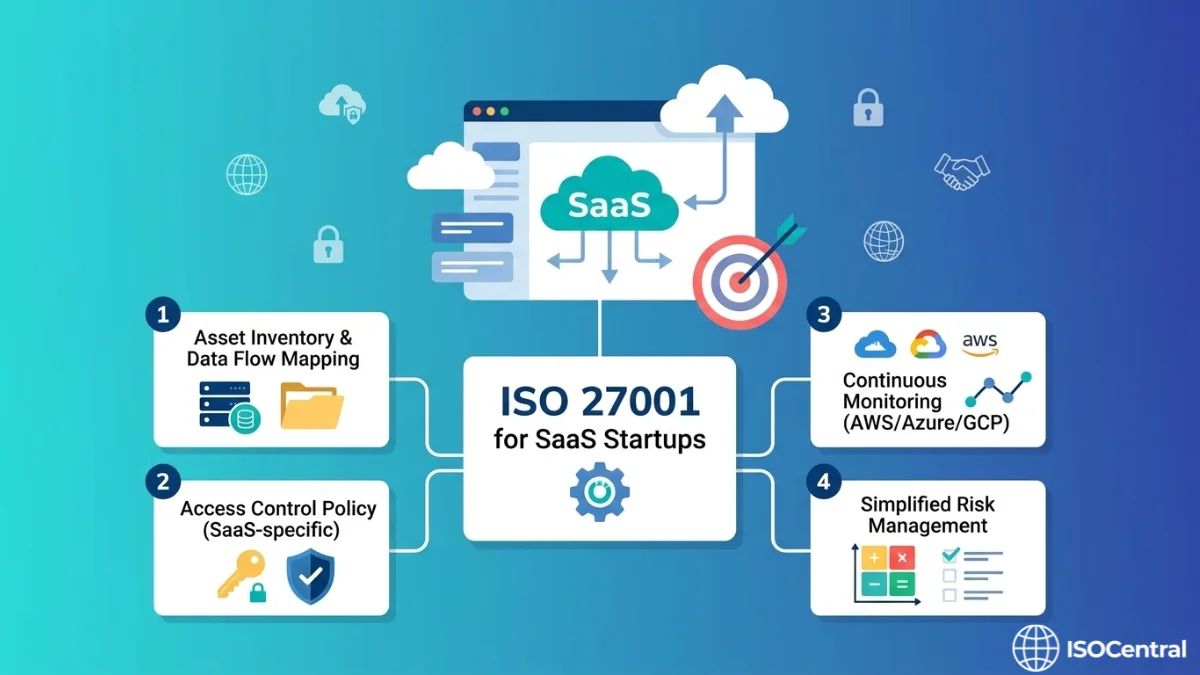
ISO 27001 has become one of the most requested certifications in the SaaS market. Enterprise customers conducting security due diligence, procurement teams running vendor risk assessments, and investors evaluating governance maturity all increasingly treat it as a baseline expectation rather than a differentiator. For a SaaS startup, the question is rarely whether to pursue it, but when and how.
This guide explains what ISO 27001 actually requires from a SaaS company, how it differs from SOC 2 and other frameworks you may have been asked about, and what a realistic implementation journey looks like for a startup with limited internal security resource. The example company used throughout is Clarevault, a 19-person B2B SaaS company based in London, providing document management software to financial services firms.
Why SaaS Startups Pursue ISO 27001
Enterprise sales require it
The most direct driver is enterprise sales. Security questionnaires sent by enterprise procurement teams routinely include ISO 27001 certification as a requirement, and the absence of certification can block deals regardless of the quality of the product. For a SaaS startup selling into financial services, healthcare, legal, or the public sector, ISO 27001 is frequently the single most impactful compliance investment available.
Clarevault lost two enterprise opportunities in a six-month period because their security posture could not be independently verified. Both prospects cited the absence of ISO 27001 as a reason for selecting a certified competitor. That commercial context drove their decision to certify, with a target of achieving certification before the next sales cycle.
Investor due diligence
Later-stage investors and acquirers increasingly include information security governance in their due diligence process. An ISO 27001 certificate signals that security is managed systematically rather than reactively, which reduces perceived risk and can support valuation. For startups approaching Series B and beyond, or preparing for an acquisition, certification provides evidence of operational maturity that goes beyond product metrics.
Building security discipline before it becomes urgent
The best time to implement ISO 27001 is before a significant security incident or a high-stakes deal that depends on it. Companies that implement it reactively, in response to a lost deal or a breach, typically do so under time pressure that compromises the quality of the implementation. Startups that build their Information Security Management System (ISMS) early develop security habits that scale with the company.
What ISO 27001 Actually Requires
ISO 27001 requires you to implement an Information Security Management System (ISMS): a systematic, documented approach to identifying your information security risks, implementing controls to address them, and continuously monitoring and improving your security posture. The standard has two main parts: the management system requirements (Clauses 4 to 10) and a reference set of controls (Annex A).
A common misconception is that ISO 27001 requires you to implement all 93 controls listed in Annex A. It does not. You are required to identify which controls are applicable to your organization based on a risk assessment, implement those that are relevant, and justify any that you have excluded in a document called the Statement of Applicability (SoA). For a SaaS startup, the applicable controls will typically center on access management, cryptography, cloud security, software development practices, incident management, and supplier security.
| Clause | Requirement | What this looks like for a SaaS startup |
|---|---|---|
| 4.1 / 4.2 | Context and interested parties | Your SaaS platform, client data held, cloud infrastructure provider, key software dependencies, regulatory context (GDPR, sector-specific rules) |
| 4.3 | ISMS scope | Define which systems, services, and data are in scope. Typically: the SaaS platform, supporting cloud infrastructure, development environment, and corporate IT |
| 6.1 | Risk assessment and treatment | Identify information security risks to your platform and client data; assess likelihood and impact; select controls from Annex A to treat each risk; produce a risk treatment plan |
| 6.1.3 | Statement of Applicability | Document which of the 93 Annex A controls are applicable, which are implemented, and justify any that are excluded. This is a central audit document |
| 6.2 | Security objectives | Measurable targets: vulnerability patch SLA, mean time to detect/respond to incidents, % staff completing security awareness training, backup restore test frequency |
| 7.2 | Competence | Security responsibilities defined per role; training records; evidence of awareness for all staff with access to systems or client data |
| 8.1 | Operational planning | Security policies covering acceptable use, access control, cryptography, remote working, software development, incident management, and supplier security |
| 8.2 | Risk assessment (ongoing) | Regular risk reviews, particularly following significant changes to the platform, infrastructure, or threat landscape |
| 9.1 | Performance monitoring | Security metrics tracked and reviewed: vulnerability scan results, incident counts, access reviews completed, audit findings addressed |
| 9.3 | Management review | Formal review with leadership covering ISMS performance, risk status, incidents, audit results, and objectives progress. At least annually |
| 10.2 | Nonconformity and corrective action | Security incident management; post-incident review; root cause analysis; corrective actions tracked to closure |
SaaS-Specific Implementation Considerations
Scoping your cloud infrastructure
Most SaaS companies run their platform on cloud infrastructure such as AWS, Google Cloud, or Azure. A common question is whether the cloud provider's own security certifications (they typically hold ISO 27001 themselves) reduce your certification burden. The answer is: partly. Under the shared responsibility model, the cloud provider is responsible for security of the infrastructure; you are responsible for security of what you build on it. Your ISMS must cover your configuration, your data, and your access controls, even if the physical infrastructure beneath it is managed by a certified provider.
When defining your ISMS scope, be explicit about which cloud services are in scope, which regions your data is stored in, and how you manage privileged access to your cloud environment. Auditors will probe these areas in detail.
Development environment and secure coding
For a SaaS company, the development environment is a significant part of the attack surface. ISO 27001 Annex A includes controls covering secure development practices, separation of development and production environments, and change management. In practice this means documenting your software development lifecycle (SDLC), your code review process, your approach to dependency management and vulnerability scanning, and how changes are promoted from development to production.
Many SaaS startups already have reasonable security practices in their development workflow but have never documented them. ISO 27001 implementation is often a process of capturing and formalizing what already happens rather than building entirely new practices.
Access control and identity management
Access control is one of the most heavily scrutinized areas in a SaaS company ISO 27001 audit. Auditors will look for evidence that access to production systems, client data, and administrative functions is controlled, logged, reviewed, and removed promptly when staff leave. This covers both your own staff's access to your infrastructure and, where relevant, client administrators' access to your platform.
Key controls to have in place include: single sign-on (SSO) with multi-factor authentication (MFA) for all systems with access to sensitive data, a joiner/mover/leaver process with documented access review cycles, privileged access management for production environments, and logs of access to client data retained for a defined period.
Supplier and subprocessor management
SaaS companies typically rely on a significant number of third-party services: payment processors, analytics tools, customer support platforms, email service providers, and so on. ISO 27001 requires you to assess the security of your suppliers, particularly those who process client data on your behalf. Under GDPR, these are your data processors, and you are required to have Data Processing Agreements in place with each of them.
You do not need to audit every supplier in detail, but you do need a documented supplier management process, a register of suppliers with their security status, and evidence that you have assessed the risk each one poses to your ISMS. Suppliers who hold their own ISO 27001 certification can be relied upon more readily than those who do not.
GDPR and ISO 27001
For SaaS companies operating in the UK or EU, or handling data about UK or EU individuals, ISO 27001 and GDPR are closely related but not the same thing. ISO 27001 covers information security management broadly; GDPR is a legal framework governing the processing of personal data. Implementing ISO 27001 will address many GDPR security requirements (Article 32 of GDPR specifically requires appropriate technical and organizational measures to protect personal data), but it does not make you GDPR compliant in full. Data subject rights, lawful bases for processing, and privacy notices are outside the scope of ISO 27001.
Some organizations also pursue ISO 27701, which extends the ISO 27001 ISMS to cover privacy information management, providing a structured framework for GDPR compliance that sits alongside the core information security standard.
ISO 27001 vs SOC 2: Which Should a SaaS Startup Pursue?
Many SaaS startups are asked about both ISO 27001 and SOC 2, particularly those with US enterprise customers or investors. They address similar territory but are fundamentally different in structure and geography.
| ISO 27001 | SOC 2 | |
|---|---|---|
| Type | International management system standard with certification | US audit report (Type I or Type II), not a certification |
| Who asks for it | Enterprise clients globally; UK and European public sector; financial services | US enterprise clients; US financial services; American government contractors |
| Ongoing | Annual surveillance audits; recertification every 3 years | Type II report covers 6-12 month observation period; renewed annually |
| Cost (typical SME) | Lower overall; UKAS-accredited CB audit typically £3,000-£8,000 | Higher; CPA firm audit typically $15,000-$50,000+ |
| Best for | UK, European, and global markets; B2B SaaS selling to enterprise | Predominantly US market; companies with US enterprise or investor focus |
For a SaaS company primarily selling in the UK and European market, ISO 27001 is almost always the right starting point. For a company with significant US enterprise revenue or US investor focus, SOC 2 Type II may be the priority. Many companies pursue both over time; ISO 27001 first is the more common sequence because it is less expensive and provides a structured ISMS foundation that makes SOC 2 easier to achieve subsequently.
A Realistic Implementation Timeline
For a SaaS startup with 10 to 30 staff, no existing ISMS, and limited internal security resource, ISO 27001 certification realistically takes four to nine months. The wide range reflects the variation in starting position: a company that already practices good security hygiene and has documented some policies will move faster than one starting from scratch.
Phase 1: Scoping and gap analysis (weeks 1 to 4)
Define the ISMS scope. Conduct a gap analysis against ISO 27001:2022 requirements. Assess which Annex A controls are potentially applicable. Identify the most significant risks to your platform and client data. Appoint an internal ISMS owner.
ISO 27001:2022, not ISO 27001:2013
The current version of the standard is ISO 27001:2022, which replaced ISO 27001:2013. The 2022 version restructured the Annex A controls from 114 to 93, reorganized into four themes. Ensure your implementation is based on the 2022 version. Certificates to the 2013 version are no longer being issued.
Phase 2: Risk assessment and treatment plan (weeks 3 to 6)
Conduct a formal risk assessment covering your information assets, threats, vulnerabilities, and existing controls. Produce a risk treatment plan identifying which controls you will implement to address each risk. Draft the Statement of Applicability, documenting which of the 93 Annex A controls apply to your organization and justifying any exclusions. This is one of the most time-consuming phases and the one most commonly underestimated.
Phase 3: Policy and control implementation (weeks 5 to 14)
Write and implement your security policies. The minimum policy set for a SaaS company typically includes: information security policy, access control policy, acceptable use policy, cryptography policy, remote working policy, software development security policy, incident management policy, supplier security policy, and business continuity policy. Beyond policies, implement the technical controls identified in your risk treatment plan: MFA, access reviews, vulnerability scanning, backup testing, and so on.
Phase 4: Evidence gathering and internal audit (weeks 12 to 18)
Run your controls for a period before the certification audit, generating evidence that they are operating effectively. This includes running access reviews, completing security training records, conducting vulnerability scans, testing backups, and reviewing supplier security status. Complete a full internal audit of the ISMS and hold a management review meeting. Nonconformities raised during the internal audit must be addressed before the certification body audit.
Phase 5: Certification audit (weeks 18 to 24)
Stage 1 audit: your chosen certification body reviews your ISMS documentation and confirms readiness for Stage 2. Stage 2 audit: the full certification assessment, typically two to three days on-site or remote for a company of this size. Nonconformities raised must be addressed before the certificate is issued. Clarevault received their certificate seventeen weeks after beginning the implementation, using a specialist information security consultancy for the risk assessment and Statement of Applicability phases.
Choosing a Certification Body for ISO 27001
For ISO 27001, sector expertise matters even more than for ISO 9001. SaaS company audits involve cloud architecture, software development practices, and data security controls that require genuine technical understanding from the auditor. Ask prospective certification bodies specifically about their experience auditing SaaS companies, cloud-native organizations, and software businesses.
In the UK, UKAS accreditation is the standard to look for. In the US, ANAB or IAS accreditation. In Ireland, INAB. Certificates from accredited bodies are recognized by enterprise security teams and procurement frameworks; those from non-accredited bodies typically are not, which defeats the primary commercial purpose of pursuing certification.
Use the ISOCentral registrar directory to find and compare accredited certification bodies with ISO 27001 and technology sector experience.