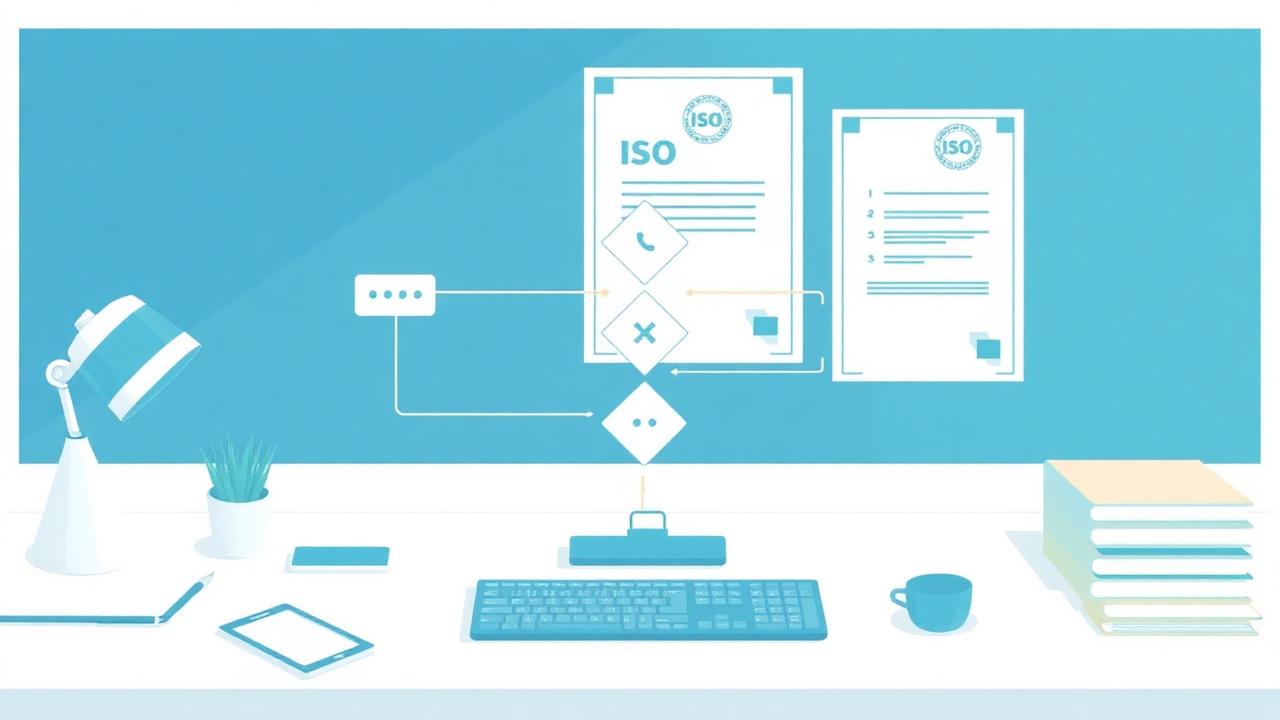
In the world of international standards, there is a common saying: "Say what you do, and do what you say." Process mapping is the primary way organizations fulfill the first half of that promise. On isocentral.org, we view process mapping as a fundamental pillar for any successful management system.
What is Process Mapping?
Process mapping is the visual representation of work activities. It shows how inputs are transformed into outputs through a series of logical steps. A process map identifies who is responsible for each task, what resources are required, and the specific sequence of events that lead to a finished product or service.
Unlike a dense text procedure, a process map provides a bird's eye view of an operation, making it much easier to identify inefficiencies and risks.
Why Process Mapping is Important for Business
Beyond simply satisfying an auditor, process mapping serves as a vital diagnostic tool for any growing organization.
Clarity and Consistency: It removes ambiguity by defining exactly how a task should be performed, ensuring that every employee produces the same high quality results.
Waste Reduction: By visualizing the workflow, management can easily spot bottlenecks, redundant steps, or unnecessary delays.
Training and Onboarding: Visual maps are significantly more effective for training new hires than long, wordy manuals.
Risk Management: It allows you to identify critical points in a process where errors are most likely to occur, enabling you to build in safeguards.
How it Benefits ISO Certification
For standards like ISO 9001, ISO 14001, and ISO 27001, the Process Approach is a mandatory requirement.
Requirement Fulfillment: Most modern ISO standards explicitly require the organization to determine the processes needed for the management system and their application throughout the business.
Evidence of Control: During an audit, a process map serves as evidence that you have thought through your operations and established controlled methods for work.
Facilitating Continuous Improvement: You cannot improve a process that you do not understand. Mapping provides the baseline data needed to measure performance and implement the Plan-Do-Check-Act cycle.
Options for Creating Process Maps
There are several ways to approach mapping, ranging from simple physical exercises to advanced digital modeling.
Workshop Style: Teams use sticky notes on a whiteboard to walk through a process together. This is excellent for gaining consensus and finding hidden issues.
SIPOC Diagrams: A high level mapping tool used to identify Suppliers, Inputs, Processes, Outputs, and Customers.
Detailed Flowcharts: Using specific symbols to represent actions, decisions, and documentation.
Value Stream Mapping: A specialized technique used in Lean management to track the flow of materials and information from the supplier to the customer.
Are Specific Qualifications Required?
There is no legal requirement or specific ISO clause that mandates a Certified Process Mapper. However, having the right expertise is highly beneficial.
Internal Knowledge: The best process mappers are often the employees who actually do the work.
Six Sigma or Lean Certification: Professionals with Green or Black Belt certifications are specifically trained in advanced mapping and optimization.
ISO Lead Auditor Training: Understanding how an auditor views a process can help you map it in a way that makes compliance easier to prove.
If your internal team lacks these skills, the ISOCentral directory can connect you with consultants who specialize in business process re-engineering.
Suitable Software for Process Mapping
In 2026, the market for mapping software is diverse, ranging from general diagramming tools to dedicated compliance platforms.
Microsoft Visio: The industry standard for technical flowcharts and detailed diagrams.
Lucidchart: A popular cloud based tool that allows for real time collaboration among team members.
Miro: Excellent for the initial sticky note style workshops and creative brainstorming.
Promapp: A dedicated tool designed specifically for business process management and ISO compliance.
AI Assisted Tools: New platforms in 2026 can now generate draft process maps by analyzing your existing text procedures or screen recordings of tasks.