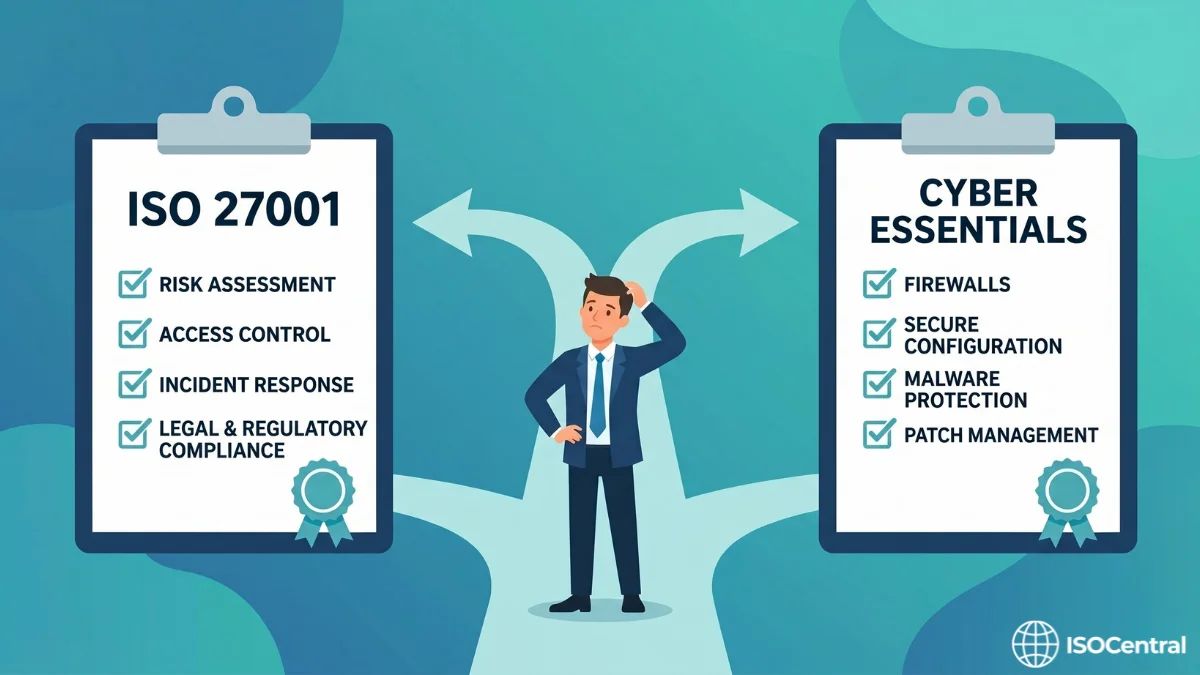
If you are trying to decide between Cyber Essentials, Cyber Essentials Plus, and ISO 27001, you are probably being pulled in different directions. A customer has asked for one of them. A tender has specified "Cyber Essentials or equivalent". A potential enterprise client has sent a security questionnaire that references both. The frameworks sound similar but they are fundamentally different in scope, rigor, and what they signal to the organizations asking for them.
This guide explains what each framework covers, where they overlap, and how to decide which one is right for your business at this stage of its development. For most UK businesses, the question is not which framework to choose permanently but which to prioritize now and how to plan a logical progression.
What Each Framework Actually Is
Cyber Essentials
Cyber Essentials is a UK government-backed scheme developed by the National Cyber Security Centre (NCSC) that certifies organizations against five fundamental security controls: firewalls, secure configuration, user access control, malware protection, and patch management. It is assessed through a self-assessment questionnaire verified by an accredited assessor.
Cyber Essentials is deliberately designed to be accessible. The five controls address the most common categories of cyber-attack and are achievable by organizations of any size without specialist security resource. Certification typically takes days to weeks rather than months, and costs a few hundred pounds for smaller organizations.
It is a UK scheme with no direct international equivalent, though the US has Cyber Essentials-adjacent programs through CISA (Cybersecurity and Infrastructure Security Agency) and similar baseline frameworks. In Ireland, the NCSC Ireland publishes guidance aligned to similar principles but there is no equivalent certification scheme.
Cyber Essentials Plus
Cyber Essentials Plus covers the same five technical controls as Cyber Essentials but adds an independent technical verification step. Rather than accepting a self-assessment, an accredited assessor conducts hands-on testing of your systems: scanning for vulnerabilities, attempting to access systems as an unauthorized user, and verifying that the controls you have declared are genuinely in place and working.
The Plus level is significantly more credible than standard Cyber Essentials because it is independently verified rather than self-declared. It costs more and takes longer, but for organizations handling sensitive data or supplying into higher-risk supply chains, it carries meaningfully more weight. Government contracts involving sensitive information typically require Cyber Essentials Plus rather than standard Cyber Essentials.
ISO 27001
ISO 27001 is an international management system standard for information security, published by the International Organization for Standardization. It requires organizations to implement an Information Security Management System (ISMS): a comprehensive, risk-based approach to identifying, managing, and continually improving information security across the entire organization.
Unlike Cyber Essentials, ISO 27001 is not a checklist of specific technical controls. It requires you to identify your own risks and implement appropriate controls from a reference set of 93 (Annex A of the standard), documenting your decisions and justifications. Certification is awarded by an independent, accredited certification body following a formal audit. In the UK, accreditation is overseen by UKAS; in Ireland by INAB; internationally through the IAF network.
ISO 27001 is recognized worldwide. A UKAS-accredited ISO 27001 certificate is understood and accepted by enterprise procurement teams, financial services regulators, and government bodies across Europe, the US, and beyond. Cyber Essentials certificates, by contrast, are primarily meaningful within UK procurement contexts.
A Direct Comparison
| Cyber Essentials | Cyber Essentials Plus | ISO 27001 | |
|---|---|---|---|
| What it covers | Five specific technical controls | Same five controls, independently verified | Organization-wide information security, risk-based approach |
| Who issues it | NCSC-approved certifying body | NCSC-approved certifying body (technical audit) | Accredited certification body (e.g. UKAS-accredited) |
| Self-assessment | Yes | No (independent testing) | No (independent audit) |
| Scope | Technical infrastructure | Technical infrastructure | Full organization and ISMS |
| Risk-based approach | No | No | Yes |
| Effort to achieve | Low | Moderate | High |
| Typical cost (SME) | From ~£400 | From ~£1,500 | From ~£5,000 total |
| Typical timeline | Days to weeks | 2 to 6 weeks | 4 to 9 months |
| Internationally recognized | No | No | Yes |
| UK public sector accepted | Yes | Yes (required for some) | Yes |
| Enterprise sales credibility | Low to moderate | Moderate | High |
| Renewal | Annual self-assessment | Annual technical audit | Annual surveillance audit |
What Each Framework Covers and What It Does Not
The limits of Cyber Essentials
Cyber Essentials is valuable precisely because it is narrow. It addresses the five technical controls that, according to NCSC data, would prevent a significant proportion of the most common cyber-attacks. But it does not address physical security, staff awareness and training, incident response, business continuity, supplier security, or data classification. An organization that holds Cyber Essentials has demonstrated a baseline level of technical hygiene; it has not demonstrated a comprehensive approach to information security.
This matters when a prospective enterprise customer or partner conducts a security due diligence assessment. Security questionnaires sent by large organizations typically ask about incident response plans, data classification policies, supplier security management, and employee security training. Cyber Essentials, even Plus, does not require any of these to be in place. A business that holds only Cyber Essentials will find it cannot answer many of the questions on an enterprise security questionnaire.
What Cyber Essentials Plus adds
Cyber Essentials Plus does not extend the scope of what is covered; it increases confidence that the five controls are genuinely implemented. For organizations where the primary question is whether their basic technical hygiene is actually working rather than just documented, Plus provides meaningful assurance. It also carries more weight in specific procurement contexts, particularly UK government contracts and supply chains handling personal or classified data.
Think of the difference between Cyber Essentials and Cyber Essentials Plus as similar to the difference between a self-declaration and a third-party verification: same questions, different level of independent confidence in the answers.
What ISO 27001 adds
ISO 27001 addresses everything that Cyber Essentials does not. A fully implemented ISO 27001 ISMS includes documented security policies, a risk assessment covering your specific threats and vulnerabilities, a structured approach to all 93 control categories in Annex A (including physical security, HR security, cryptography, business continuity, and supplier management), a staff awareness and training program, an incident management process, and a continual improvement cycle.
Critically, ISO 27001 also requires you to demonstrate that the system is operating effectively over time, through internal audits, management reviews, and annual surveillance audits. A certificate is not awarded for having documentation in place but for having a living management system that is embedded in how the organization actually operates.
The result is that an ISO 27001 certificate signals something fundamentally different from a Cyber Essentials certificate. It tells a customer or procurement team that your organization has assessed its specific information security risks, implemented appropriate controls across the full scope of its operations, and has an independent body verifying this on an ongoing basis.
Do the Frameworks Overlap?
There is partial overlap. The five technical controls covered by Cyber Essentials map broadly onto a subset of the Annex A controls in ISO 27001, particularly those covering access control, network security, and malware protection. If you have implemented Cyber Essentials genuinely, some of that work will be usable as evidence when you pursue ISO 27001.
However, the overlap is smaller than it might appear. ISO 27001 requires controls to be documented, risk-based, and subject to ongoing management review. Cyber Essentials does not. A business that has ticked the Cyber Essentials boxes without embedding them into a documented, managed system will need to revisit much of that work when implementing ISO 27001.
The most useful way to think about it: Cyber Essentials gets you to a baseline of technical hygiene that you should have in place regardless. ISO 27001 builds a management system around information security that encompasses that baseline and goes significantly further. Cyber Essentials is a starting point, not a stepping stone that does most of the ISO 27001 work for you.
Which Framework Does Your Business Need?
The honest answer depends on who is asking and why. Use the guide below as a starting point.
| Your situation | Recommended path |
|---|---|
| UK government contract or tender requiring Cyber Essentials | Cyber Essentials |
| UK government contract or tender requiring Cyber Essentials Plus | Cyber Essentials Plus |
| Public sector contract involving sensitive or personal data | Cyber Essentials Plus |
| Enterprise client security questionnaire asking about ISO 27001 | ISO 27001 |
| SaaS company selling to enterprise or financial services clients | ISO 27001 |
| Small business wanting baseline cyber hygiene at low cost | Cyber Essentials |
| Organization wanting to demonstrate security to US clients or investors | ISO 27001 |
| Regulated sector (financial services, legal, healthcare) | ISO 27001 |
| Building supply chain credibility in a non-technical SME | Cyber Essentials |
| Wanting to comply with UK government supply chain requirements now, plan ISO 27001 | Both: CE first |
| Enterprise SaaS or MSP with a mix of UK and international clients | Both: ISO 27001 first |
Cost and Timeline Comparison
Cyber Essentials
For organizations with fewer than 50 employees, Cyber Essentials certification starts from around £400 through IASME-approved certifying bodies, which include the vast majority of approved Cyber Essentials assessors. The assessment is primarily documentation-based and can typically be completed in a matter of days once you have answered the questionnaire. Annual renewal is required.
Cyber Essentials Plus
Cyber Essentials Plus adds a technical assessment on top of the standard self-assessment. Costs vary but typically range from £1,500 to £5,000 for an SME, depending on the size and complexity of the IT estate. The assessment itself takes one to three days and must be completed within three months of passing Cyber Essentials. Annual renewal requires a repeat technical assessment.
ISO 27001
ISO 27001 involves both implementation costs and certification body fees. For a small business pursuing ISO 27001 for the first time, total costs including implementation (whether self-managed or consultant-supported) and certification body audit fees typically range from £5,000 to £15,000. Larger or more complex organizations can expect significantly more. Annual surveillance audit fees are typically £1,500 to £3,500. For a detailed breakdown, use the ISOCentral cost calculator.
Pursuing Both: Does It Make Sense?
Many organizations end up holding both Cyber Essentials and ISO 27001, and this is a sensible long-term position. Cyber Essentials is often required by specific contracts or frameworks regardless of whether you hold ISO 27001. The two certifications serve different audiences and answer different questions, so holding both removes friction in procurement conversations across a wide range of customer types.
The sequencing question is worth thinking through carefully. For most UK SMEs that do not yet have either, starting with Cyber Essentials is the right move: it is faster, cheaper, provides immediate commercial value in UK procurement contexts, and gives you a documented baseline of technical controls that will serve as evidence in your later ISO 27001 implementation.
For organizations that are specifically being held back by the absence of ISO 27001 in enterprise sales conversations, pursuing ISO 27001 directly is the more efficient path. The additional work of achieving Cyber Essentials alongside it is modest, and the two can be achieved in parallel without significant additional effort.
A note on Cyber Essentials Plus and ISO 27001 together
Cyber Essentials Plus covers your technical controls with independent verification. ISO 27001 covers your entire information security management approach, including those same technical controls and much more besides.
If you hold both, you have strong coverage at every level: verifiable technical hygiene (CE+) and a comprehensive, risk-based management system audited by an accredited body (ISO 27001). For organizations in regulated sectors or with a high-value client base, this is a compelling security posture to be able to demonstrate.
A Note for Businesses in Ireland and the US
Cyber Essentials is a UK government scheme administered by IASME and NCSC. It has no direct equivalent in Ireland or the US and is not widely recognized outside UK procurement contexts. Businesses in Ireland pursuing government or enterprise contracts should look to ISO 27001 (INAB-accredited) as the primary security management certification, alongside GDPR compliance obligations. The Irish NCSC publishes cyber security guidance but does not operate an equivalent accreditation scheme.
In the US, ISO 27001 is increasingly recognized by enterprise procurement teams but the dominant framework for US government supply chains is CMMC (Cybersecurity Maturity Model Certification). SOC 2 Type II is the most commonly requested by US enterprise clients in the private sector. US businesses considering international expansion should prioritize ISO 27001, which is accepted globally, over SOC 2 alone.